Fear and Education

This was my first blog post for The American Academy of Physician Assistants PA Blog in a recurring series called “Professor’s Corner”. 


           Fear is good.  It is a strong statement and is bound to invoke certain emotional feelings, which may not always be positive in nature.  Think back to the last time you were truly scared.  Chances are you can remember more than you think about the event in question.  Cognitive psychologists have studied the effect of fear on attention, as well as retention, and shows there may be a “sweet spot” for a “healthy amount” of stress that is beneficial to learners.  The trick is not only finding that perfect zone for each student, but also adjusting it throughout the 2.5 years of school. 

            The fear and stress at the beginning of the didactic phase of PA education is most commonly caused by grades and doing well on exams.  Many of you may have gone through undergraduate studies with very high marks, and maybe even didn’t have to study all that hard.  Then PA school hits you like a freight train.  So what happens?  You commit “academic bulimia”……binging on large amount of information for exams and then completely purging it from memory to make space for the next exam.  Very little retention takes place, but the fear of doing well in school is tempered.  Compare this to the end of the didactic year when you have your studying methods down, but you are preparing for clinical rotations and suddenly you think you “can’t remember anything”.  Now the fear is shifted from grades, to trying to remember as much as possible to take care of actual patients.  While on clinical rotations, your fear is redirected once again to trying to recall any information from your didactic year so you don’t look incompetent in front of your patients or preceptors.

            Our jobs as professors in PA programs is to instilling aliquots of fear in safe environments to get you ready to practice medicine.  Maybe it is using more simulation in a group setting.  Maybe it is calling on you in class.  Maybe it is pop quizzes.  Maybe it is comprehensive final exams.  The method to our madness……stress inoculation.  By doing small stressful tasks throughout your classroom instruction, we are trying to prepare you for learning in the clinical environment.  Simulation prepares you to make clinical decisions in low-stakes environments.  Calling on you in class prepares you for the Socratic method of teaching that permeates the halls of the hospitals.  Pop quizzes and comprehensive finals teaches you to be self-directed, intrinsic learners that will persist for your entire medical career.

              Fear is good.  No other profession has the life or death struggle that medicine embraces.  The moment you do not fear taking care of patients is the moment you may cause someone harm.  Part of the educational process of PA school is to teach you how to manage this fear.  Every time you overcome fear, you become stronger.  Suddenly, thinking about getting called out in class by a professor in a class of your peers is nothing compared to getting called on by your attending in front a group of strangers….or telling a patient they have terminal cancer.  Harnessing this fear and helping you focus it will not only help you be the best clinician possible, but it will indirectly help every one of your patients you take care for the rest of your career.

References

1)  Vermeulen N, Godefroid J, Mermillod M (2009) Emotional Modulation of Attention: Fear Increases but Disgust Reduces the Attentional Blink. PLoS ONE 4(11): e7924.

2)  Schwabe L, Joels M, Roozendaal B, Wolf OT, Oitzl MS.  Stress effects on memory:  An update and integration.  Neuroscience and Biobehavioral Reviews.  2012;36:1740-1749.

3)  Susskind JM, Lee DH, Cusi A, Feiman, Grabski W, Anderson AK.  Expressing fear enhances sensory acquisition.  Nature Neuroscience.  2008;11(7):843-850.

4)  Perry B.  Fear and Learning: Trauma-Related Factors in Adult Education Process.  New Directions for Adult and Continuing Education.  2006;110:21-27.

#5 – Aortic Dissections


***Listen to podcast by clicking here***


Cliff Reid - SMACC 2015

Cliff Reid – SMACC 2015

Background

  • 1st described by German anatomist Daniel Sennert in 16th century on autopsy
  • King George II of England died of aortic dissection in 1760 and described by Frank Nichols
  • John Ritter (Actor) died of dissection
  • Relatively uncommon, but can be fatal if missed
  • 3-5 cases/100,000 each year
  • Mortality rates around 25%
  • 22% undiagnosed prior to death

Pathophysiology

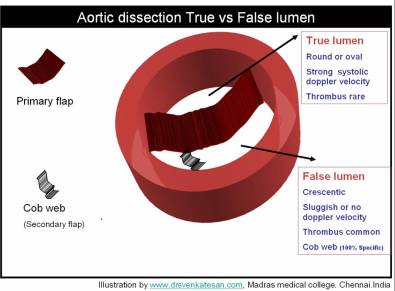
  • Tear in aortic intima that leads to false lumen between intima and media
    • majority occur in ascending aorta between the sinotubular junction and left subclavian artery
  • Bimodal age distribution
    • Teens-30yo and > 50yo

Risk Factors

  • Chronic hypertension
  • Connective tissue disorders
    • Marfans, Ehler-Danlos
  • Bicuspid aortic valve
  • Previous aortic instrumentation
  • Family history of dissections

Classification

  • DeBakey (older)
    • Uses site of origin
      • Type I
        • Originates in ascending and includes the arch
      • Type II
        • Originates and confined to ascending aorta
      • Type III
        • Originates in descending and extends proximal/distal
  • Stanford (more widely used)
    • Stanford A
      • Involves the ascending aorta
    • Stanford B
      • Everything else
  • Newer DISSECT classification can be used to help with treatment options
    • Duration
      • Acute = < 2 weeks
      • Subacute = 2 weeks to 3 months
      • Chronic = > 3 months
    • Intimal Tear
      • Primary location
        • Ascending
        • Aortic Arch
        • Descending
        • Abdomen
    • Size of Aorta
      • Maximum trans-aortic diameter within dissected segment
    • Segmental Extent of aortic involvement
      • Broken down in to sections from arch to iliacs
    • Clinical complications associated with dissection
    • Thrombus of aortic false lumen
      • Patent or not

Clinical Presentations

  • History
    • Pain (90%)  – sharp > ripping/tearing
      • Chest in Type A (83%)
      • Back (64%) and abdominal (43%) in Type B
    • Neurologic
      • Syncope, stroke symptoms (more common in Type A)
      • Type B – paraplegia from Artery of Adamkiewicz
      • Horner’s Syndrome from compression on superior cervical ganglion
      • Hoarseness from compression on left recurrent laryngeal nerve
  • Physical Exam
    • Tamponade (most common cause of death) in Type A or Type I
      • Beck’s Triad
        • Hypotension, JVD, muffled heart tones
    • Can be hypertensive or hypotensive
    • Pulse deficits (> 20mmHg variation)
      • Higher mortality if present
      • Depends on the site (up to 30% of Type A vs 10% of Type B)
      • Older patients less likely to have pulse discrepancy
    • Heart murmur (more common in younger patients)
      • Aortic regurgitation (50-66%)
        • Diastolic decrescendo murmur
        • Heard best over right sternal border
          • as opposed to classic primary aortic disease AR which is heard over the left sternal border
  • Pre-test Probability
    • 77% of patients have 2 out of the 3 high-risk variables:
      • Variation in pulse or blood pressure
      • Presence of CXR abnormality
      • Abrupt onset of sharp, chest/abdominal pain

Diagnostic Studies

  • EKG (almost always 1st study done for chest pain)
    • Not very helpful other than to R/O ACS
      • May be normal in 19-31% of dissections
    • May see abnormal changes if dissection involves coronary arteries
  • Chest Radiograph
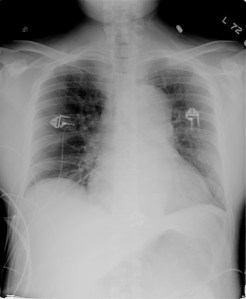
    • Classic finding is widening of the mediastinum or aortic silhouette
      • Incidence ~ 60%
    • Up to 30% of patients with aortic dissection have no CXR abnormality

  • D-Dimer
    • Extensively studied…but essentially worthless
      • When < 500 ng/mL:
        • Sensitivity – 97%, Negative Predicative Value – 96%
        • Specificity – 56%
        • False negative rate of 18%
  • Computed Tomography Angiography (hemodynamically stable)
    • Test of choice for diagnosis
    • Findings of acute dissection:
      • Intimal flap
      • True and false lumen
      • Pericardial effusion
  • Echocardiography (hemodynamically unstable)
    • Transesophageal (preferred)
      • Sensitivity/specificity can approach CT numbers
      • Require procedural sedation
    • Transthoracic (acceptable)
      • Quicker, no sedation, inferior sensitivity/specificity to CT

Intimal Flap

Treatment

  • Acute Management
    • Control of heart rate and blood pressure
      • Systolic BP < 120 mmHg
      • Heart rate < 60 bpm
    • Medications
      • IV Beta-blocker (1st line)
        • Esmolol (0.1-0.5 mg/kg over 1 minute followed by 0.025-0.2 mg/kg/hr)
        • Labetalol (20mg bolus followed by 0.5-2 mg/hr)
        • Propanolol (1-10mg load followed by 3 mg/hr)
      • If hypertensive after beta-blockade:
        • Nitroprusside (0.25-0.5 mcg/kg/min)
        • Nicardipine (5mg/hr, increase 2.5 mg/hr q15min to max 15mg/hr)
  • Definitive Management
    • Type A (surgical emergency)
      • Mortality rate 1-2% per hour after symptom onset
      • Open repair on bypass
        • Median sternotomy with graft placement +/- aortic valve replacement
        • May need to re-implant coronary and/or great vessels
      • > 90% 3yr survival after surgery


  • Type B
    • Uncomplicated
      • Medical therapy
        • BP goal = < 120/80 mmHg
        • Oral beta-blocker is 1st line
        • Add ACE inhibitors or calcium channel blocker to BP goal
      • Serial Imaging
        • CT or MRI at 3, 6, and 12 months
        • If no progression, then every 1-2 years
      • Complicated (or progressing)
        • Endovascular graft surgery
          • Indications
            • Involvement of major aortic branch leading to end organ ischemia
            • Persistent HTN or pain
            • Aneurysmal dilation
            • Concomitant connective tissue disorder


References

  1. Sennertus D: Cap. 42, Op Omn Lib. 5:306-315, 1650
  2. Nichols F. Observations concerning the body of his late majesty, October 26, 1760, Phil Trans Lond. 52:265-274, 1761.
  3. Pacini D, Di marco L, Fortuna D, et al. Acute aortic dissection: epidemiology and outcomes. Int J Cardiol. 2013;167(6):2806-12.
  4. Hagan PG, Nienaber CA, Isselbacher EM, et al. The International Registry of Acute Aortic Dissection (IRAD): new insights into an old disease. JAMA. 2000;283(7):897-903.
  5. Olsson  C, Thelin  S, Stahle  E  et al.: Thoracic aortic aneurysm and dissection: increasing prevalence and improved outcomes reported in a nationwide population-based study of more than 14,000 cases from 1987-2002. Circulation 114: 2611, 2006.
  6. E. DeBakey, W.S. Henley, D.A. Cooley, G.C. Morris, E.S. Crawford, A.C. Beall. Surgical management of dissecting aneurysms of the aorta.  J Thorac Cardiovasc Surg. 1965;49:130–149
  7. O. Daily, H.W. Trueblood, E.B. Stinson, R.D. Wuerflein, N.E. Shumway. Management of acute aortic dissections.  Ann Thorac Surg. 1970;10:237–247.
  8. Dake MD, Thompson M, Van sambeek M, Vermassen F, Morales JP. DISSECT: a new mnemonic-based approach to the categorization of aortic dissection. Eur J Vasc Endovasc Surg. 2013;46(2):175-90.
  9. Dake MD, Thompson M, Van sambeek M, Vermassen F, Morales JP. DISSECT: a new mnemonic-based approach to the categorization of aortic dissection. Eur J Vasc Endovasc Surg. 2013;46(2):175-90.
  10. Pape, L. A., Awais, M., Woznicki, E. M., Suzuki, T., Trimarchi, S., Evangelista, A., Myrmel, T., Larsen, M., Harris, K. M., Greason, K., Di Eusanio, M., Bossone, E., Montgomery, D. G., Eagle, K. A., Nienaber, C. A., Isselbacher, E. M., & O’Gara, P. Presentation, Diagnosis, and Outcomes of Acute Aortic Dissection: 17-Year Trends From the International Registry of Acute Aortic Dissection. Journal of the American College of Cardiology. 2015;4:350–358.
  11. Mehta, R. H., O’Gara, P. T., Bossone, E., Nienaber, C. A., Myrmel, T., Cooper, J. V., Smith, D. E., Armstrong, W. F., Isselbacher, E. M., Pape, L. A., Eagle, K. A., Gilon, D. Acute type A aortic dissection in the elderly: clinical characteristics, management, and outcomes in the current era. Journal of the American College of Cardiology. 2002;4:685–692.
  12. Movsowitz, H. D., Levine, R. A., Hilgenberg, A. D., & Isselbacher, E. M. Transesophageal echocardiographic description of the mechanisms of aortic regurgitation in acute type A aortic dissection: implications for aortic valve repair. Journal of the American College of Cardiology. 2000;3:884–890.
  13. Biagini E, Lofiego C, Ferlito M, et al. Frequency, determinants, and clinical relevance of acute coronary syndrome-like electrocardiographic findings in patients with acute aortic syndrome. Am J Cardiol. 2007;100(6):1013-9
  14. Von kodolitsch Y, Schwartz AG, Nienaber CA. Clinical prediction of acute aortic dissection. Arch Intern Med. 2000;160(19):2977-82.
  15. Hogg K, Teece S. Best evidence topic report. The sensitivity of a normal chest radiograph in ruling out aortic dissection. Emerg Med J. 2004;21(2):199-200.
  16. Shimony A, Filion KB, Mottillo S, Dourian T, Eisenberg MJ. Meta-analysis of usefulness of d-dimer to diagnose acute aortic dissection. Am J Cardiol. 2011;107(8):1227-34.
  17. Sueyoshi E, Nagayama H, Hayashida T, Sakamoto I, Uetani M. Comparison of outcome in aortic dissection with single false lumen versus multiple false lumens: CT assessment. Radiology. 2013;267(2):368-75.
  18. Moore AG, Eagle KA, Bruckman D, et al. Choice of computed tomography, transesophageal echocardiography, magnetic resonance imaging, and aortography in acute aortic dissection: International Registry of Acute Aortic Dissection (IRAD). Am J Cardiol. 2002;89(10):1235-8.
  19. Hiratzka LF, Bakris GL, Beckman JA, et al. 2010 ACCF/AHA/AATS/ACR/ASA/SCA/SCAI/SIR/STS/SVM guidelines for the diagnosis and management of patients with Thoracic Aortic Disease: a report of the American College of Cardiology Foundation/American Heart Association Task Force on Practice Guidelines, American Association for Thoracic Surgery, American College of Radiology, American Stroke Association, Society of Cardiovascular Anesthesiologists, Society for Cardiovascular Angiography and Interventions, Society of Interventional Radiology, Society of Thoracic Surgeons, and Society for Vascular Medicine. Circulation. 2010;121(13):e266-369.
  20. Tsai TT, Nienaber CA, Eagle KA. Acute aortic syndromes. Circulation. 2005;112(24):3802-13.
  21. Trimarchi S, Nienaber CA, Rampoldi V, et al. Contemporary results of surgery in acute type A aortic dissection: The International Registry of Acute Aortic Dissection experience. J Thorac Cardiovasc Surg. 2005;129(1):112-22.