Hematology/Oncology Case #1

62-year-old male presents to primary provider’s office with a six-month history of fatigue and gait disturbance.  He denies recent falls, weakness, pain, paralysis, or dizziness.


Medications

Lisinopril 10mg daily

Metformin 1000mg BID

Men’s multivitamin

Fish oil


Past Medical History

Diabetes Mellitus II

Hypertension

Gastric cancer


Past Surgical History

Cholecystectomy – 1997

Partial gastrectomy – 2004


Vitals

BP-128/79, HR-81, RR-14, O2-100%, Temp-98.9o


Physical Exam

General – WN/WD, NAD

Skin – scattered senile purpura, no petechiae

CV – RRR without M/G/R

Pulmonary – CTA bilaterally without adventitial breath sounds

Neurologic – A&Ox3, 5/5 strength throughout bilaterally, DTR 2+ and equal, FROM, vibratory sensation decreased in bilateral lower extremities


Laboratory Studies
Case#1

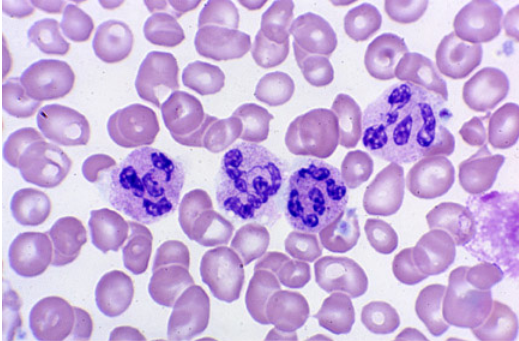
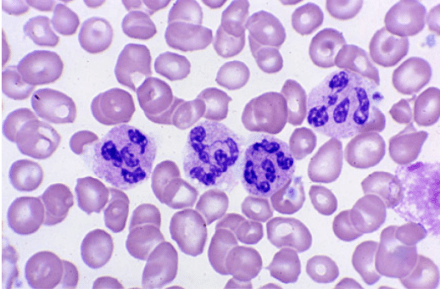
Hypersegmented Neutrophils


#9 – The CBC Demystified


***Listen to the podcast here***


White Blood Cell Count

  • Normal range (4.0-11.0 x 10³ cells/mm3)
  • 2 Parts
    • Actual count of the number of leukocytes in one cubic millimeter of blood
    • Differential count (% of each of the 5 types of leukocytes)
  • < 4.0 x 10³ cells/mm3 = leukopenia
    • Bone marrow failure, blood malignancies, infections
  • > 11.0 x 10³ cells/mm3 = leukocytosis
    • Infections, inflammation, blood malignancies
  • Differential
    • Granulocytes
      • Neutrophils (45-73%)
        • Bands (3-5%)
        • “Left shift”
        • Absolute Neutrophil Count (ANC)
          • (%PMN + %Bands) x WBC / 100
          • < 1500 = neutropenia
      • Eosinophils (0-4%)
      • Basophils (0-1%)
    • Non-granulocytes
      • Lymphocytes (20-40%)
        • 3 Main Types
          • T-Cells = cell mediated immunity
          • B-Cells = humoral immunity (immunoglobulins)
          • Natural Killer Cells (NKC)
      • Monocytes (2-8%)

Never Let Monkeys Eat Bananas

Red Blood Cell Count

  • Actual count of RBC in one cubic millimeter of blood
    • Normal range
      • Male (4.5-5.9 x 10¹² cells/L)
      • Female (4.1-5.1 x 10¹² cells/L)
    • Reasons for gender differences in RBC markers
      • Blood loss from menstruation
      • Testosterone is hematapoetic
    • 2 main markers
      • Hemoglobin
        • Amount of Hgb contained in a given volume of blood
        • Normal Range
          • Male (14-17.5 g/dL)
          • Female (12.3-15.3 g/dL)
      • Hematocrit
        • % of total blood volume made up by RBC
        • Normal range
          • Male (42-50%)
          • Female (36-45%)
        • As a general rule of thumb, most agreed upon transfusion trigger is Hgb < 7.0 g/dL and/or Hct < 20%

Red Blood Indices

  • Essentially assess the size and hemoglobin content of the RBC and is useful in the evaluation of anemias, polycythemias, and nutritional deficiencies
  • Mean Corpuscular Volume (MCV)
    • Average size of the volume of RBC (Hct/RBC count)
    • Normal range (80-100 fL/cell)
      • < 80 = Microcytic
      • > 100 = Macrocytic
  • Mean Corpuscular Hemoglobin (MCH)
    • Average amount of hemoglobin within a RBC
    • Closely resembles MCV and of little clinical use
  • Mean Corpuscular Hemoglobin Concentration (MCHC)
    • Calculation of Hgb/Hct
    • Normal range (32-36 g/dL)
      • < 32 = hypochromic
      • > 36 = hyperchromic
  • Red Blood Cell Distribution Width (RDW)
    • Indication of RBC size variability (degree of anisocytosis)
    • Normal range (11-14%)
  • Reticulocyte Count
    • Measure of immature RBC in circulation
      • Evaluates bone marrow function and erythropoetic activity
    • Normal range (0.5-2.5%)
    • Reticulocyte Index
      • Measures whether this response is appropriate
      • Reticulocyte Count % x (Patient’s Hct/Normal Hct)
        • < 1.0 = poor response

Platelet Count

  • Actual count of thrombocytes in one cubic millimeter of blood
  • Normal range (150,000-450,000/µL)
  • Mean Platelet Volume (MPV)
    • Relationship between size and count
    • Immature platelets are larger
    • MPV is analogous to the MCV

Strategies for Quick Interpretation

  • If abnormal WBC:
    • Correlate with clinical picture
      • An abnormal number may be a normal response to illness or a marker of illness severity
    • Look at your differential
    • If leukopenic, then calculate ANC
  • If abnormal RBC:
    • Is your patient symptomatic?
    • Look at your indices
    • Calculate reticulocyte count for response
  • If abnormal platelet:
    • Is the patient bleeding?
Untitled-1

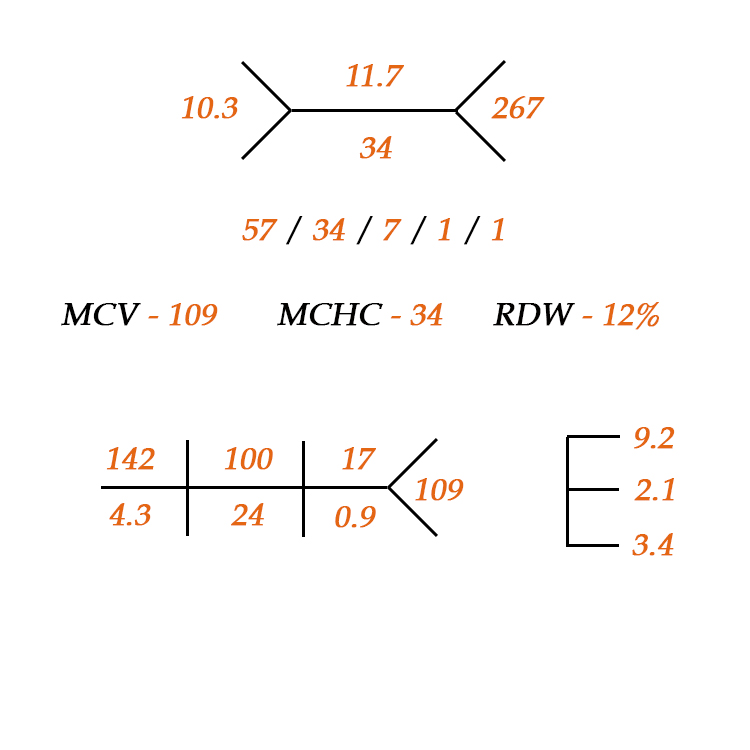
Fishbone diagram for CBC with differential

References

1) Pagana KD, Pagana TJ.  Mosby’s Manual of Diagnostic and Laboratory Tests.  5th ed.  St. Louis, MO. Elsevier. 2014.

2) Lee M.  Basic Skills in Interpreting Laboratory Data.  5th ed.  Bethesda, MD.  American Society of Health-Systems Pharmacists.  2013

3) Laposata M.  Laboratory Medicine: The Diagnosis of Disease in the Clinical Laboratory.  2nd ed.  New York, NY.  2014.