Ep-PAINE-nym


Epstein-Barr Virus

Other Known Aliases Human gammaherpesvirus 4

Definition – double-stranded DNA herpes virus that infects B lymphocytes and epithelial cells and has both active replication and latency periods that can cause disease

Clinical Significance known to the be the causative pathogen for infectious mononucleosis, it is also associated Burkitt’s lymphoma, Hodgkin’s lymphoma, and other various other diseases and cancers. It is transmitted through oral transfer of saliva and genital secretions

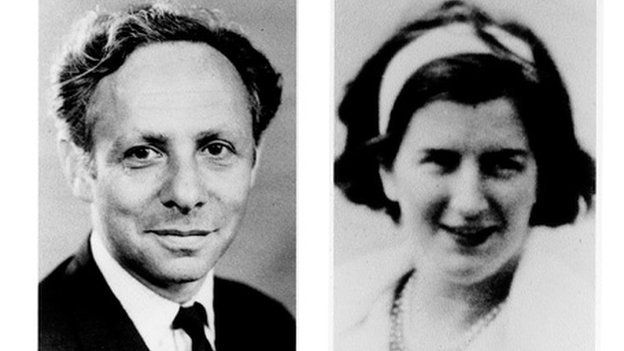
HistoryNamed after Sir Michael Anthony Epstein (1921-), a British pathologist who received his medical doctorate from Cambridge University, and Yvonne Barr (1932-2016), an Irish pathologist who received her PhD from the University of London in 1966. Upon hearing a lecture by Denis Burkitt in 1961 on a new endemic cancer in Africa, the former decided to change his career path to search for the cause of this cancer. After working for two years on tumor cells from this cancer, he, with the help of the later as a PhD student, finally isolated the virus cell lines and published their preliminary findings, with colleague Bert Achong, in the Lancet in 1964.

References

  1. Firkin BG and Whitwirth JA.  Dictionary of Medical Eponyms. 2nd ed.  New York, NY; Parthenon Publishing Group. 1996.
  2. Bartolucci S, Forbis P.  Stedman’s Medical Eponyms.  2nd ed.  Baltimore, MD; LWW.  2005.
  3. Yee AJ, Pfiffner P. (2012).  Medical Eponyms (Version 1.4.2) [Mobile Application Software].  Retrieved http://itunes.apple.com.
  4. Whonamedit – dictionary of medical eponyms. http://www.whonamedit.com
  5. Up To Date. www.uptodate.com
  6. EPSTEIN MA, ACHONG BG, BARR YM. VIRUS PARTICLES IN CULTURED LYMPHOBLASTS FROM BURKITT’S LYMPHOMA. Lancet. 1964; 1(7335):702-3. [pubmed]
PAINE #PANCE Pearl – Pulmonology


Question

A 68yo man, with a history of COPD and 57-pack-year history of smoking, presents to the office with worsening shortness of breath on exertion, dizziness, and leg swelling over the past 6-months. He states that his inhalers don’t seem to be helping as much and he is finding it more and more difficult to walk without getting breathless. He denies orthopnea, paroxysmal nocturnal dyspnea, or increased cough. Vital signs show BP-157/98 mmHg, HR-88 bpm, RR-23 bpm, O2-90% on room air, and temp-98.9o. Physical examination reveals (+) JVD, widened split S2, 1+ pitting edema of the legs to the knee, and hepatomegaly. EKG is below.

  1. What does the EKG show?
  2. What is the diagnosis?
  3. What is the next step in evaluation?
  4. What is the definitive diagnostic study for this condition?


Answer

  1. The EKG shows numerous findings of chronic pulmonary disease including:
    • Right axis deviation
    • Peaked P-waves (>2.5mm) in inferior leads (II, III, aVF)
    • Clockwise rotation of the heart with delayed R/S transition point
    • Absent R-waves in right precordial leads (V1-V3)
    • Low voltage left sided leads
  2. Given the absence of left sided heart failure and the patients extensive pulmonary history, the presentation is highly suggestive of pulmonary hypertension with cor pulmonale.
    • Cor pulmonale is a complication of pulmonary hypertension and is defined as structural alterations or impaired function of the right ventricle
  3. The next step in evaluation of this patient is getting an echocardiogram to evaluate global heart function and degree of pulmonary hypertension present
  4. The definitive diagnostic study of pulmonary hypertension and cor pulmonale is a right heart catheterization.


References

  1. https://litfl.com/ecg-in-chronic-obstructive-pulmonary-disease/

Ep-PAINE-nym


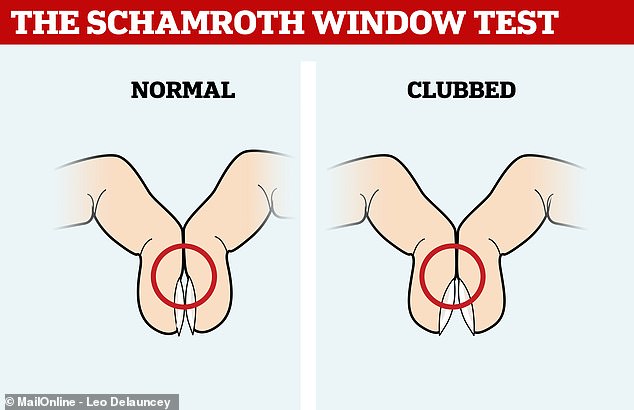
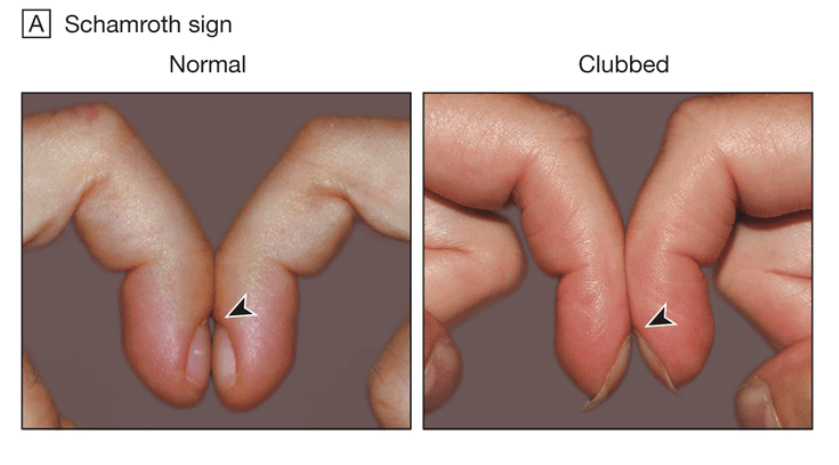
Schamroth Test

Other Known Aliases none

Definition – test used for diagnosing nail clubbing by examining the window seen between the nails of opposite fingers

Clinical Significance there should be a diamond size window in “normal” nails when performing this test. In patients with nail clubbing, this window is obliterated

HistoryNamed after Leo Schamroth (1924-1988), a Belgium-born, South African cardiologist who received his medical doctorate from the University of Witwatersrand in 1948. He completed his residency at Johannesburg General Hospital and joined the staff at Baragwanath Hospital in 1956, where he would stay his entire career culminating in chief physician in 1972. He would publish over 300 papers and eight textbooks in the realm of cardiology, and his Introduction to Electrocardiography is still one of the most stolen medical textbooks in the world. He published his eponymous finding in an article entitled “Personal Experience” in 1972 in the South African Medical Journal.


References

  1. Firkin BG and Whitwirth JA.  Dictionary of Medical Eponyms. 2nd ed.  New York, NY; Parthenon Publishing Group. 1996.
  2. Bartolucci S, Forbis P.  Stedman’s Medical Eponyms.  2nd ed.  Baltimore, MD; LWW.  2005.
  3. Yee AJ, Pfiffner P. (2012).  Medical Eponyms (Version 1.4.2) [Mobile Application Software].  Retrieved http://itunes.apple.com.
  4. Whonamedit – dictionary of medical eponyms. http://www.whonamedit.com
  5. Up To Date. www.uptodate.com
  6. Schamroth L. Personal experience. S Afr Med J. 1976; 50(9):297-300. [pubmed]

PAINE #PANCE Pearl – Pulmonology


Question

A 68yo man, with a history of COPD and 57-pack-year history of smoking, presents to the office with worsening shortness of breath on exertion, dizziness, and leg swelling over the past 6-months. He states that his inhalers don’t seem to be helping as much and he is finding it more and more difficult to walk without getting breathless. He denies orthopnea, paroxysmal nocturnal dyspnea, or increased cough. Vital signs show BP-157/98 mmHg, HR-88 bpm, RR-23 bpm, O2-90% on room air, and temp-98.9o. Physical examination reveals (+) JVD, widened split S2, 1+ pitting edema of the legs to the knee, and hepatomegaly. EKG is below.

  1. What does the EKG show?
  2. What is the diagnosis?
  3. What is the next step in evaluation?
  4. What is the definitive diagnostic study for this condition?

Ep-PAINE-nym


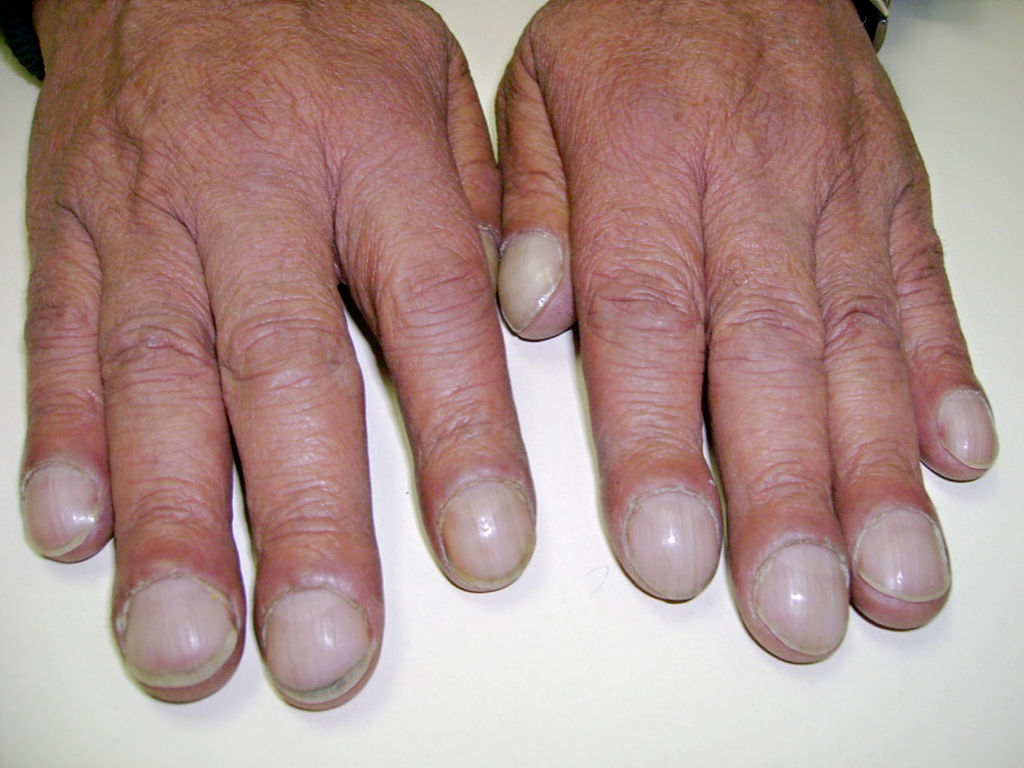
Hippocratic Fingers

Other Known Aliases clubbing of the fingers

Definition – soft tissue swelling of the terminal phalynx

Clinical Significance this is a nonspecific clinical finding that can be caused by numerous diseases, but is classically associated with any disease that can cause physiologic hypoxia. The exact mechanism for development is unknown, but is theorized to be caused by vasodilation, secretion of growth factors, overproduction of prostaglandin E2, and increased entry of megakaryocytes.

HistoryNamed after Hippocrates (460-370 BC), who was a Greek physician and is considered to be the “Father of Medicine”, due to his approach in observation of clinical diseases. Though I cant find an original source for this eponym, it is one of those historical “facts” that nobody really challenges.


References

  1. Firkin BG and Whitwirth JA.  Dictionary of Medical Eponyms. 2nd ed.  New York, NY; Parthenon Publishing Group. 1996.
  2. Bartolucci S, Forbis P.  Stedman’s Medical Eponyms.  2nd ed.  Baltimore, MD; LWW.  2005.
  3. Yee AJ, Pfiffner P. (2012).  Medical Eponyms (Version 1.4.2) [Mobile Application Software].  Retrieved http://itunes.apple.com.
  4. Whonamedit – dictionary of medical eponyms. http://www.whonamedit.com
  5. Up To Date. www.uptodate.com