Question
In an oliguric patient, what is the first step in differentiating between prerenal and intrinsic renal causes?



In an oliguric patient, what is the first step in differentiating between prerenal and intrinsic renal causes?

Other Known Aliases – none
Definition – spiral fracture of the proximal third of the fibula caused by pronation with external rotation


Clinical Significance – This injury is a sequelae of significant ankle trauma with disruption of the distal tibiofibular syndesmosis and can be unstable. It is also one of the criteria of the Ottawa Rules of the Ankle so you don’t miss these
History – Named after Jules Germain François Maisonneuve (1809-1897), a French surgeon who studied under Guillaume Dupuytren in the mid-1800s. He first reported this injury pattern in 1840 in the article entitled Recherches sur la fracture du Péroné. He was also the first surgeon to advocate the use of external fixation in the management of ankle fractures

References

What rheumatologic disease can be summed up the phrase “can’t see, can’t pee, can’t climb a tree”?

The triad of ocular symptoms (conjunctivitis, uveitis, episcleritis, keratitis), genitourinary symptoms (dysuria, urethritis, cervicitis) and musculoskeletal symptoms (arthritis, enthesitis, dactylitis) are diagnostic of reactive arthritis.

Other Known Aliases – Chauffeur fracture, backfire fracture
Definition – intra-articular fracture of the radial styloid

Clinical Significance – This injury most commonly occurs from either direct trauma to the dorsum of the hand or from FOOSH with forced dorsiflexion and abduction
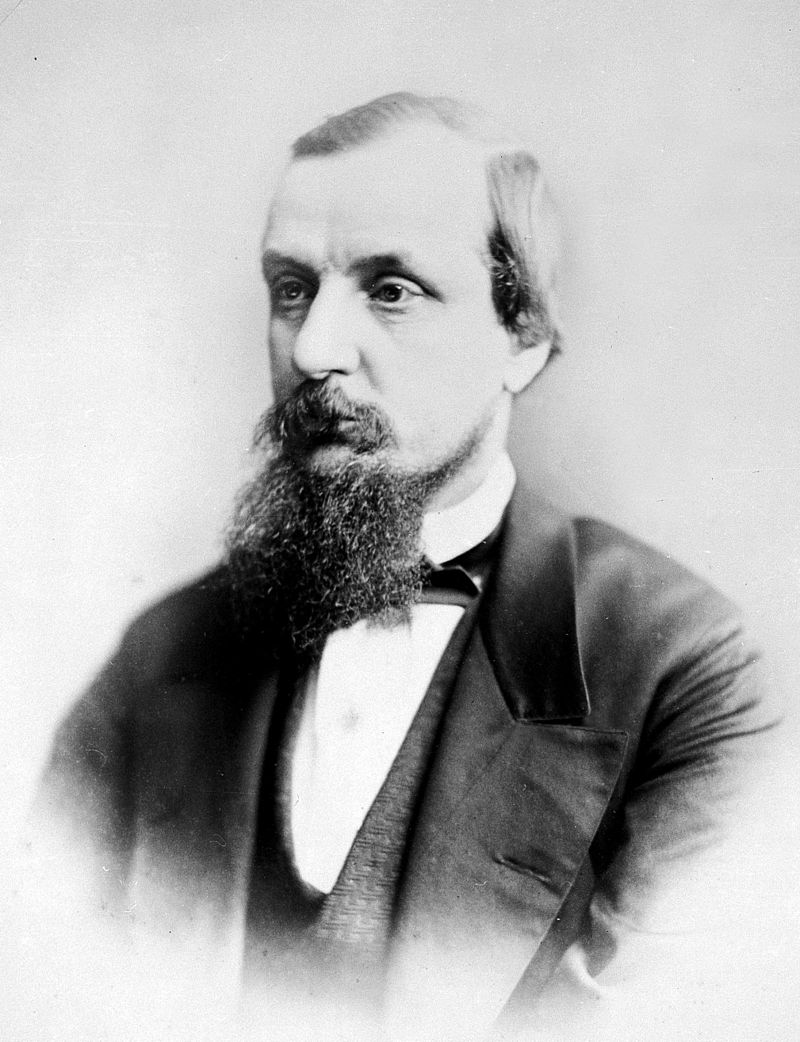
History – Named after Jonathan Hutchinson (1828-1913), who was an English physician and surgeon and received his medical doctorate from St. Bartholomew’s Hospital in London in 1850. He enjoyed a prolific career practicing in ophthalmology and pathology, while also serving as president for numerous medical societies. Dr. Hutchinson also produced more than 1200 medical articles and study extensively on infectious diseases. In 1908, he was knighted by Edward VII for his contributions to medicine. The colloquial term of chauffeur fracture comes from the fact that when the chauffeur would hand crank the car and the car backfired, the handle would shoot back and impact the palm of the hand.
References
What rheumatologic disease can be summed up the phrase “can’t see, can’t pee, can’t climb a tree”?
Other Known Aliases – none
Definition – osteophytic growths on the distal interphalangeal joints of the fingers and toes


Clinical Significance – Most commonly seen in osteoarthritis and similar to, but much more common than, Bouchard’s nodes of the proximal interphalangeal joints. They are much more common in women and seem to have a genetic predisposition.
History – Named after William Heberden (1710-1801), who was an English physician and received his medical doctorate from St. Johns College in Cambridge in 1739, where he made his name a distinguished medical lecturer at the university. He received fellowship in the Royal College of Physicians in 1746 and then the Royal Society in 1749. He enjoyed a prolific medical practice in London and Paris for over 30 years. While semi-retired, he worked on a collection of papers for the Royal College of Physicians to be transcribed into a three volume textbook entitled Medical Transactions. These were eventually revised and transcribed in English, by his son William Heberden the younger, which included a chapter on arthritis by Heberden the elder describing these findings.


References
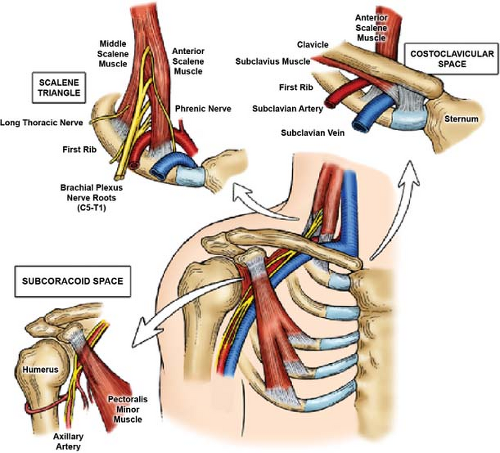
Thoracic outlet syndrome is constellation of signs and symptoms due to compression of the neurovascular bundle in the upper thorax.

Other Known Aliases – none
Definition – nodular growths on the proximal interphalangeal joints of the fingers and toes


Clinical Significance – Most commonly seen in osteoarthritis and similar to Heberden’s nodes of the distal interphalangeal joints, though they are less common.
History – Named after Charles Jacques Bouchard (1837-1915), a French pathologist who received his medical doctorate in 1866 while studying under the famous Dr. Jean Martin Charcot. He practiced at the Bicêtre Hospital where he was appointed chair of general pathology in 1879. His seminal work was the Traité de Pathologie Générale, which was a compendium of medical pathology and where the description of his eponymous findings were first recorded.


References
Thoracic outlet syndrome is constellation of signs and symptoms due to compression of the neurovascular bundle in the upper thorax.
Other Known Aliases – none
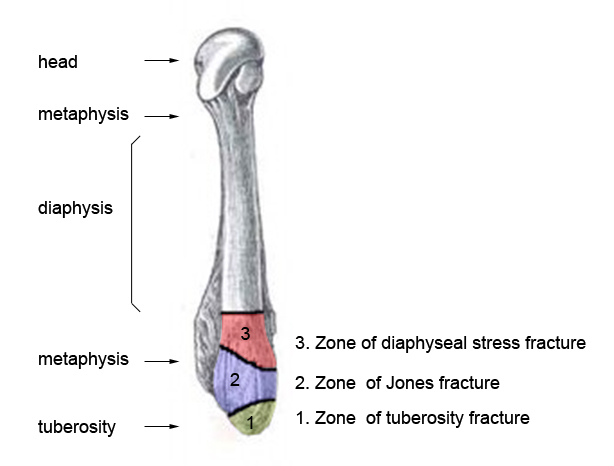
Definition – fracture of the base of the 5th metatarsal at the metaphyseal-diaphyseal junction
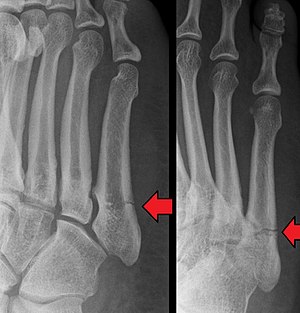
Clinical Significance – Fairly easy radiographical diagnosis to make, but careful examination must distinguish between acute injuries in Zone 1 and 2 and chronic injuries in Zone 3.

History – Named after Sir Robert Jones (1857-1933), a Welsh orthopaedic surgeon and received his medical doctorate from the Liverpool School of Medicine in 1887 and achieved fellowship in 1889. Along with his uncle, he was a pioneer in the diagnosis and management of fractures. He first described the injury that bears his name in 1902 in the Annals of Surgery entitled “Fracture of the Base of the Fifth Metatarsal by Indirect Violence”. This paper was a six patient case report on the injury pattern and Dr. Jones was patient number one having injured his foot several months prior dancing. After Wilhem Rontgen published his discovery of x-rays in 1895, Dr. Jones adopted this new modality fully in the practice of orthopaedics and published the first clinical radiograph in 1896 about a 12yo with a bullet lodged in his wrist that could not be found clinically and required a 2hr long exposure.

References
 PAINE Podcast and Medical Blog