Ep-PAINE-nym


Loop of Henle

Other Known Aliasesansa nephroni

Definitionportion of the nephron that goes from the proximal convoluted tubule to the distal convoluted tubule. There are four portions of this structure:

  • Thin descending segment
  • Thin ascending segment
  • Ascending limb
  • Cortical thick ascending limp

Clinical Significance the loop of Henle creates an area of high urea concentration with secretion and reabsorption of water and electrolytes. This is also the portion of the nephron where the aptly named “loop diuretics” to manage blood pressure by means of excess fluid excretion.

HistoryNamed after Friedrich Gustav Jakob Henle (1809-1885), who was a German physician, pathologist, and anatomist and received his medical doctorate from the University of Bonn in 1832. He spent his early career as a prosector for Johannes Müller in Berlin where he published furiously on numerous facets of human and animal anatomy and physiology. He then went on to become the chair of anatomy at the University of Zurich, where he became one of the early adopters and advocates for the study of pathophysiology as a single distinct discipline. He also set the early argument for the germ theory in an essay entitled “On Miasma and Contagia”. His life’s work culminated in the publishing of the Handbook of Systematic Human Anatomy in 1855, which was the most complete and comprehensive work at that time.


References

  1. Firkin BG and Whitwirth JA.  Dictionary of Medical Eponyms. 2nd ed.  New York, NY; Parthenon Publishing Group. 1996.
  2. Bartolucci S, Forbis P.  Stedman’s Medical Eponyms.  2nd ed.  Baltimore, MD; LWW.  2005.
  3. Yee AJ, Pfiffner P. (2012).  Medical Eponyms (Version 1.4.2) [Mobile Application Software].  Retrieved http://itunes.apple.com.
  4. Whonamedit – dictionary of medical eponyms. http://www.whonamedit.com
  5. Up To Date. www.uptodate.com
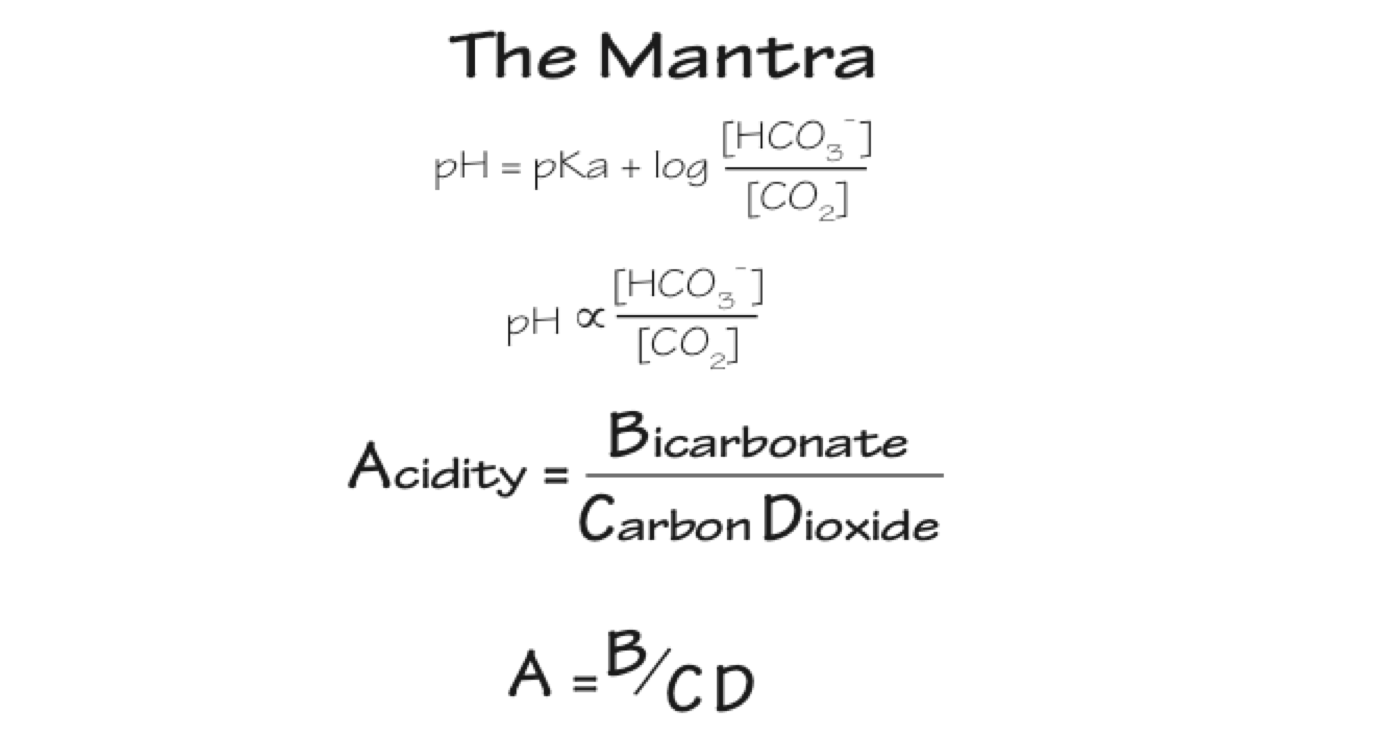
#43 – ABG Interpretation


Ground Rules

  1. Accurate assessment of a patient’s acid/base status requires a measurement of arterial pH and PCO2
    1. bedside analyzers directly measure these and then use the Henderson-Hasselbach equation to calculate the HCO3-
    2. You can use venous blood, but must make adjustments:
      1. pH is 0.03-0.04 lower than arterial
      2. PCO2 is 7-8 mmHg higher than arterial
      3. HCO3- is 2 mEq/L higher than arterial
    3. A primary disturbance is usually accompanied by a compensatory response, but does not fully correct the pH


There are four main ways pH can change:

  • Metabolic Alkalosis
    • increase in HCO3- and increase in pH
  • Metabolic Acidosis
    • Decrease in HCO3- and decrease in pH
  • Respiratory Alkalosis
    • Decrease in PCO2 and increase in pH
  • Respiratory Acidosis
    • Increase in PCO2 and decrease in pH


Remember, that the lungs can compensate considerable FASTER than the kidneys.

  • Lungs can excrete 12 moles of acid per day as CO2
  • Kidneys can excrete 0.1 moles of acid per day as ammonia, but can secrete HCO3- to buffer


Respiratory Acidosis

  • Decrease in minute ventilation (TV x RR)
  • Causes
    • Normal Lungs
      • CNS depression (drugs, head trauma)
      • Neuromuscular impairment (GBS, MG)
      • Thoracic restriction
    • Abnormal Lungs
      • Obstruction
      • Alveoli dysfunction (ARDS)
      • Perfusion defect (cardiac arrest, PTE)
  • Compensation
    • Acute
      • Increase of 10 mmHg of PaCO2 will increase serum HCO3- by 1 mEq/L
    • Chronic
      • Increase of 10 mmHg of PaCO2 will increase serum HCO3- by 3 mE1/L

Respiratory Alkalosis

  • Increase in minute ventilation (TV x RR)
  • Causes
    • Cardiac
    • Hypoxemia
    • Anemia
    • Medications
    • Pregnancy
    • Iatrogenic
    • Obstruction
    • Neurologic
    • Stress
  • Compensation
    • Acute
      • Decrease of 10 mmHg of PaCO2 will decrease serum HCO3- by 2 mEq/L
    • Chronic
      • Decrease of 10 mmHg of PaCO2 will decrease serum HCO3- by 4 mEq/L

If the condition is 100% acute respiratory, then the pH will change 0.08 for every 10 mmHg change in PaCO2


Metabolic Acidosis

  • Decreased pH due to decreased HCO3-
  • First step after determining that a patient has a metabolic acidosis is to calculate the anion gap
  • High Anion Gap Metabolic Acidosis (HAGMA)
    •  Causes
      • Carbon monoxide, cyanide
      • Aminoglycosides
      • Theophyline, toluene
      • Methanol
      • Uremia
      • Diabetic ketoacidosis
      • Propylene glycol
      • Inborn errors of metabolism
      • Lactic acidosis
      • Ethylene glycol, ethanol
      • Salicylates

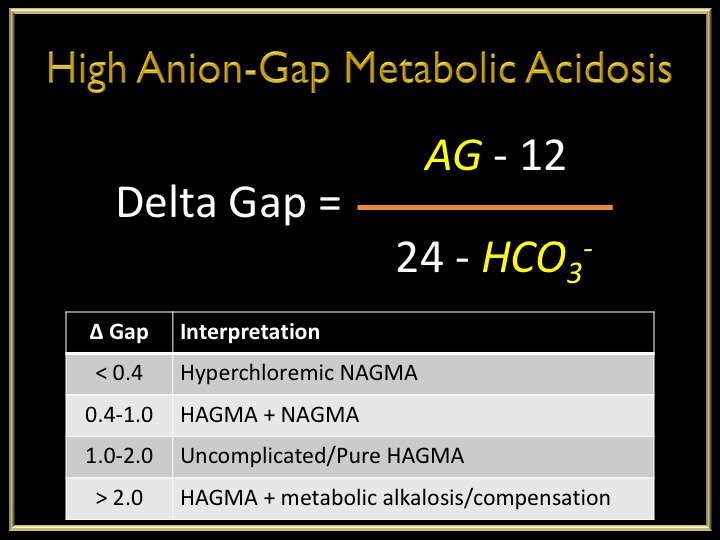
  • Calculating a Delta Gap

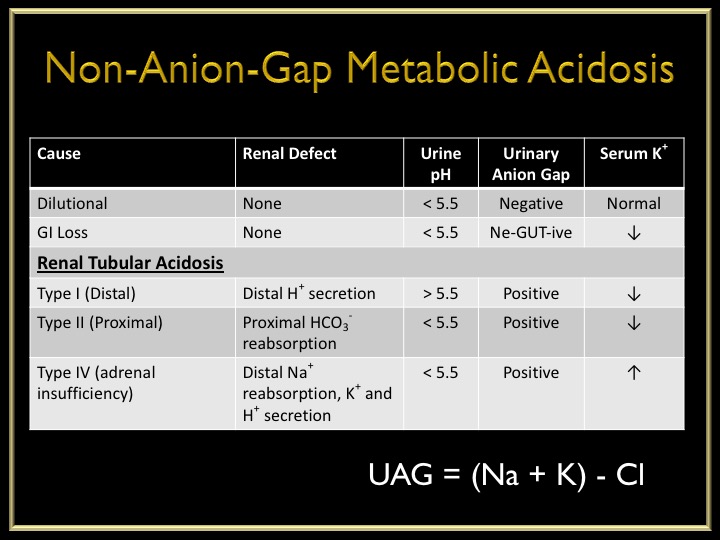
  • Normal Anion Gap Metabolic Acidosis (NAGMA)
    • Causes
      • Ureteric diversion
      • Small bowel fistulae
      • Excessive saline
      • Diarrhea
      • Carbonic anhydrase inhibitors
      • Renal tubular acidosis
      • Adrenal insufficiency
      • Pancreatic fistulae

  • Respiratory Compensation
    • Expected PaCO2 = 8 + (1.5 x HCO3-) ± 2

Metabolic Alkalosis

  • Increased pH due to increased HCO3-
  • Causes
    • Contraction
    • Licorice
    • Endocrine
    • Vomiting
    • Excessive NG suction
    • Ringer’s solution
    • Post-hypercapnia
    • Diuretics
  • Respiratory Compensation
    • Expected PaCO2 = 20 + (0.7 x HCO3-) ± 5 

PAINE #PANCE Pearl – Renal


Question


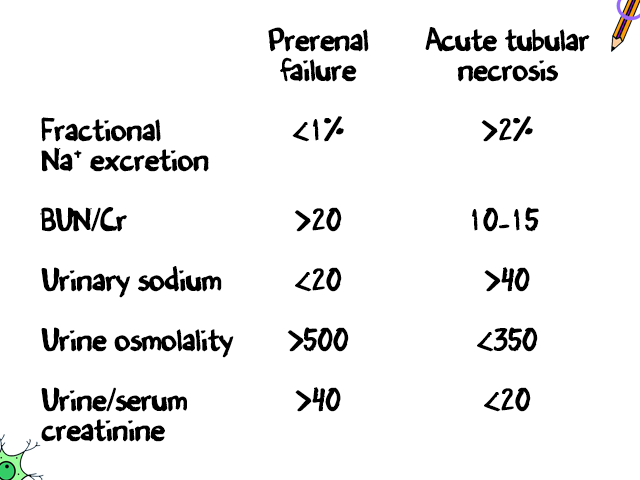
In an oliguric patient, what is the first step in differentiating between prerenal and intrinsic renal causes?


Answer


The fractional excretion of sodium (FENa) can help differentiate prerenal from intrinsic renal causes in patient with oliguria.  If the FENa is < 1%, it suggests prerenal and if it is > 2%, it suggests intrinsic renal causes.  There are many limitations to using this calculation, but it is a good first step in determining the cause of a patient’s oliguria.  Other laboratory studies, such as BUN/Cr, can be useful as well.


Image result for fractional excretion of sodium

Ep-PAINE-nym


Bowman’s Capsule


Other Known AliasesCapsula glomeruli, glomerular capsule

DefinitionDouble walled, cup-like capsule surrounding the glomerulus

Image result for bowman's capsule

Clinical SignificanceIt is made up of two poles: a vascular pole (afferent and efferent arterioles) and a urinary pole (proximal convoluted tubule). Within the capsule, there is a parietal layer and visceral layer with a space in between.  This is where ultrafiltration takes place and urine is filtered from the blood.

History – Named after Sir William Bowman (1816-1892), who was an English ophthalmologist, histologist, and anatomist, and first identified this structure in 1841.  He published his findings at the age of 25 and was awarded The Royal Medal by the Royal Society of  London.

He was well known for his extensive use microscopes in visualizing structures of the human body and publishing two works with his mentor, Robert Bentley Todd, entitled “Physiological Anatomy and Physiology of Man” and “Cyclopaedia of Anatomy and Physiology”.

William Bowman.jpg

The Cyclopaedia Of Anatomy And Physiology


References

  1. Firkin BG and Whitwirth JA.  Dictionary of Medical Eponyms. 2nd ed.  New York, NY; Parthenon Publishing Group. 1996.
  2. Bartolucci S, Forbis P.  Stedman’s Medical Eponyms.  2nd ed.  Baltimore, MD; LWW.  2005.
  3. Yee AJ, Pfiffner P. (2012).  Medical Eponyms (Version 1.4.2) [Mobile Application Software].  Retrieved http://itunes.apple.com.
  4. Whonamedit – dictionary of medical eponyms. http://www.whonamedit.com
  5. Bowman W.  On the Structure and Use of the Malpighian Bodies of the Kidney.  Phil Trans R Soc Lond.  1842;132:57-80
  6. Eknoyan G. Sir William Bowman: his contributions to physiology and nephrology. Kidney international. 1996; 50(6):2120-8. [pubmed]
  7. Galst JM. Sir William Bowman (1816-1892). Archives of ophthalmology (Chicago, Ill. : 1960). 2007; 125(4):459. [pubmed]

Ep-PAINE-nym


Gerota’s Fascia


Other Known AliasesRenal fascia

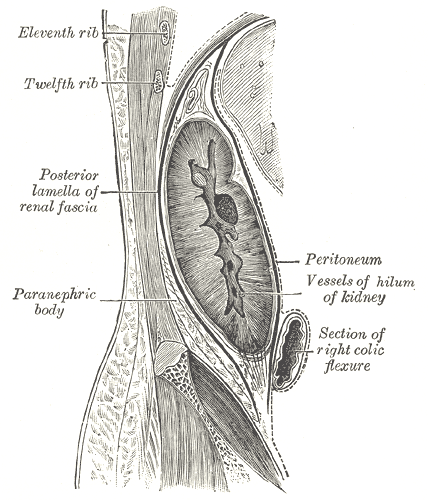
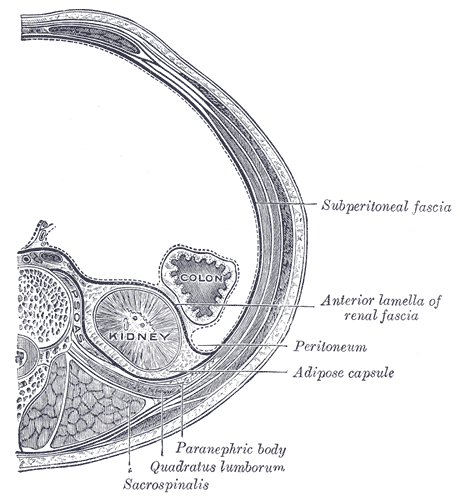
DefinitionConnective tissue layers covering the kidneys and adrenal glands

Clinical Significance This connective tissue encapsulates these organs and must be excised to perform nephrectomies and adrenalectomies.  It has 4 attachments:

  • Anterior attachment – Connects the anterior layer of the renal fascia of the opposite kidney.
  • Posterior attachment – Connects the psoas fascia and the body of the vertebrae.
  • Superior attachment – The anterior and posterior layers fuse at the upper pole of the kidney and then split to enclose the adrenal gland. At the upper part of the adrenal gland they again fuse to form the suspensory ligament of the adrenal gland and fuse with the diaphragmatic fascia.
  • Inferior attachment – The posterior layer descends downwards and fuses with the iliac fascia. The anterior layer blends with the connective tissue of the iliac fossa.

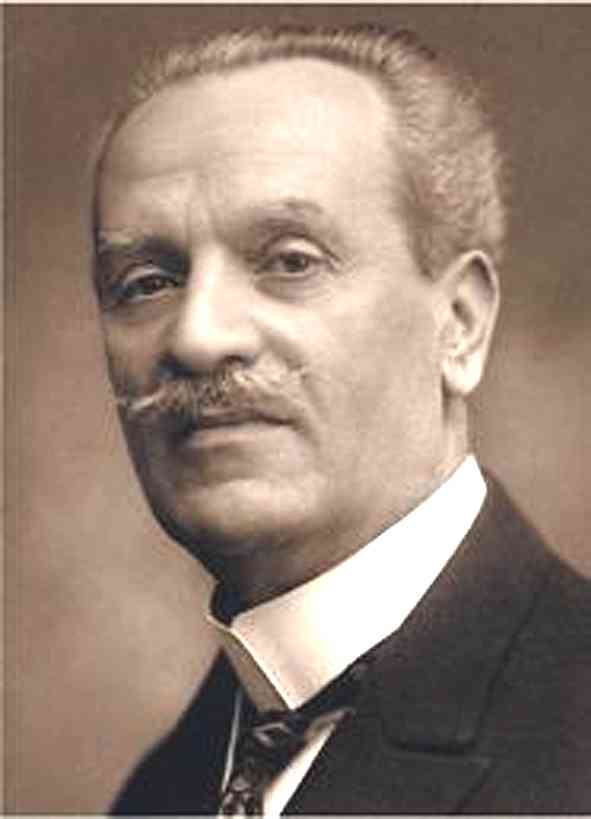
History – Named after Dimitrie D. Gerota (1867-1939), who was a Romanian physician and professor of surgical anatomy and experimental surgery at the University of Bucharest.  He was also the first radiologist in Romania and developed a method for injecting lymphatic vessels known as “The Gerota Method”

13-foto1


References

  1. Firkin BG and Whitwirth JA.  Dictionary of Medical Eponyms. 2nd ed.  New York, NY; Parthenon Publishing Group. 1996.
  2. Bartolucci S, Forbis P.  Stedman’s Medical Eponyms.  2nd ed.  Baltimore, MD; LWW.  2005.
  3. Yee AJ, Pfiffner P. (2012).  Medical Eponyms (Version 1.4.2) [Mobile Application Software].  Retrieved http://itunes.apple.com.
  4. Whonamedit – dictionary of medical eponyms. http://www.whonamedit.com