PAINE #PANCE Pearl – Surgery Edition


Question


What are the boundaries of Calot’s Triangle and what can be found there?


Answer


Calot’s Triangle is the area bordered by:

  1. Cystic duct
  2. Common hepatic duct
  3. Cystic artery

A lymph node can be found within this triangle and there is apparently great debate about the name of this node.   I had learned this was referred to as Calot’s node (which makes sense, right), but it is more accurately named Lund’s, or Mascagni’s, node.  This node can be enlarged and inflamed with cholecystitis.

The anatomical area is referred to as the cystohepatic triangle and is bordered by:

  1. Cystic duct
  2. Common hepatic artery
  3. Superior, inferior margin of the liver

The reason for this distinction from Calot’s Triangle is because the cystic artery can be found within this region.

Blue = Calot’s and Red = Cystohepatic


References

  1. Blackbourne LH.  Surgical Recall.  6th Edition.  2012.
  2. Haubrich WS. Calot of the triangle of Calot. Gastroenterology. 2002; 123(5):1440. [pubmed]
  3. Miranda, Efrain A., PhD. “Triangle of Calot.” Medical Terminology Daily. N.p., 10 May 2016. Web. 10 June 2017.

Ep-PAINE-nym


Whipple Operation


Other Known AliasesKausch-Whipple procedure

DefinitionRadical pancreaticoduodenectomy with distal antrectomy, cholestectomy, and pancreaticojejunostomy, choledocojejunostomy, and gastrojejunostomy

Clinical Significance Used for resection of carcinoma of the head of the pancreas.

History – The first resection of a periampullary cancer was performed by German surgeon Walther Kausch (1867-1928) in 1909, took four hours to complete, and the patient survived for 9 months.  American surgeon Allen Oldfather Whipple (1881-1963) began working on and refining the procedure in 1935 and in 1940, successfully shortened it to a one-stage procedure.


References

  1. Firkin BG and Whitwirth JA.  Dictionary of Medical Eponyms. 2nd ed.  New York, NY; Parthenon Publishing Group. 1996.
  2. Bartolucci S, Forbis P.  Stedman’s Medical Eponyms.  2nd ed.  Baltimore, MD; LWW.  2005.
  3. Yee AJ, Pfiffner P. (2012).  Medical Eponyms (Version 1.4.2) [Mobile Application Software].  Retrieved http://itunes.apple.com.
  4. Whonamedit – dictionary of medical eponyms. http://www.whonamedit.com/. Accessed March 7, 2017.
  5. Whipple AO. Observations on radical surgery for lesions of the pancreas. Surgery, gynecology & obstetrics. 1946; 82:623-31. [pubmed]

#15 – Appendicitis


***LISTEN TO THE PODCAST HERE***


Epidemiology

  • 1st described in the late 1400s and 1st published in 1544 by Jean Fernal
  • 1st appendectomy was performed in 1736 on an 11yo boy
  • 233/100,000 population
  • May occur throughout life, but is most common age group is 10-19yo and slightly more common in men
  • Badass of the Millennium goes to….Leonid Rogozov.  He was the only physician on a Soviet team in Antarctica in 1961 and performed an appendectomy…on himself…and survived (Article here)
Picture1

Leonid Rogozov performing an appendectomy on himself – 1961


Anatomy of the Appendix

Wikipedia

Wikipedia

  • Located where the taenia coli converge at the base of cecum
  • Average length 6-9cm, outer diameter 3-8mm, and luminal diameter 1-3mm
  • Arterial supply is from appendicular branch of the ileocolic artery
  • The attachment of the base of the appendix is constant, but the tip may be positioned:
    • Retrocecal (most common)
    • Subcecal
    • Preileal
    • Postileal
    • Pelvic
Wikipedia

Wikipedia


Pathogenesis

  • Follows traditional predictable series of events for inflammation of a hollow visceral organ:
    • Inflammation
      • Most commonly by an obstruction
        • Fecalith, calculi, lymphoid hyperplasia, infection, mass
        • Causes a closed-loop obstruction
    • Distention
      • Normal secretion and bacterial overgrowth
        • Causes visceral nerve pain
      • Luminal pressure > perfusion
        • Involves the serosa
          • Causes parietal pain
    • Perforation
      • As areas of ischemia progress and pressures increase, perforation may occur
        • May be contained (localized) or cause peritonitis
      • Although this progression is predictable, the time frame may be variable
        • Perforation may occur anywhere from 24-48 hours after symptom onset

History

  • Abdominal pain occurs first
    • Starts as diffuse, periumbilical
    • Appendix position may alter pain location
  • Nausea and vomiting then follows
  • Anorexia (Negative Cheeseburger Sign)
  • Last is migratory pain to RLQ (50-60%)

Physical Examination

  • Often non-specific as appendix position, time course of illness, and patient anatomy may obscure findings
  • Classic physical exam findings include:
    • McBurney’s Point Tenderness
      • Maximal tenderness 3cm from ASIS, or 1/3rd the distance from ASIS to umbilicus
  • 4
    • Rovsing’s Sign
      • Palpation or rebound pressure of LLQ causes RLQ pain
    • Psoas Sign (retrocecal)
      • Pain in RLQ when ipsilateral hip is extended or flexed against resistance
    • Obsturator Sign (pelvic)
      • Pain in RLQ with internal rotation of ipsilateral hip with flexed knee
    • Guarding and peritoneal signs may be seen with perforation

5


Laboratory Studies

  • CBC with differential and CRP are needed for the scoring systems, but are not very specific

Pretest Probability Scoring Systems

  • Alvarado Score
    • Developed in 1986 and modified in 1994
  • Appendicitis Inflammatory Response (AIR) Score
    • Developed in 2008
  • Pediatric Appendicitis Score
    • Developed in 2002

Screen Shot 2016-06-15 at 12.39.04 PM

  • Interpretation
    • Alvarado Score
      • 0-3 – low probability (discharge)
      • 4-6 – indeterminate (image or admit)
      • ≥ 7 – high probability (admit or surgery)
    • AIR Score
      • 0-4 – Low probability (discharge)
      • 5-8 – Indeterminate (image or admit)
      • ≥ 9 – high probability (admit or surgery)
    • PAS
      • < 3 – low probability (discharge)
      • 3-7 – indeterminate (image or admit)
      • ≥ 8 – high probability (admit and consult)

Radiographic Imaging

  • Imaging is generally reserved for indeterminate cases or special populations (children, women, elderly) as clinical examination is just as effective as imaging in ruling-out appendicitis
  • Computed Tomography
    • IV contrast
    • Findings suggesting appendicitis:
      • ≥ 6mm diameter
      • Appendiceal wall thickening ≥ 2mm
      • Periappendiceal fat stranding
      • Appendicolith
  • Ultrasound
    • Study of choice in children and pregnant women and becoming study of choice in adults
    • Findings suggestive of appendicitis:
      • Aperistaltic, noncompressible, dilated (> 6mm) appendix
      • Distinct appendiceal wall layers
      • Echogenic prominent pericecal fat
      • Periappendiceal fluid collection
      • Target appearance on axial section
Metanalyses Comparing CT to US in Appendicitis

Metanalyses Comparing CT to US in Appendicitis


Management

  • Nonoperative Management
    • Several studies have looked at antibiotic management of uncomplicated appendicitis and found:
      • Up to 53% of antibiotic-only management still required surgery within 48hr
      • Antibiotic-only patients had lower pain scores and quicker return to work
      • Up to 37% of antibiotic-only patients required surgery for recurrent appendicitis within 2 years
      • Most recent study (APPAC Trial, JAMA, 2015) did meet prespecified criterion for noninferiority
      • May be an options for special populations
        • Poor surgical candidates, patients who refuse surgery
    • As for now, there isn’t enough good data to support routine, nonoperative management for uncomplicated appendicitis
  • Operative Management
    • Uncomplicated
      • Urgent (12-24hr) vs Emergent (< 12hr)
        • No difference in outcomes
        • 7
    • Complicated (perforation with abscess)
      • Sick or with generalized peritonitis = emergent surgery
      • Limited peritonitis
        • Antibiotics, bowel rest, percutaneous drainage
        • Interval appendectomy after improvement in clinical course
    • Laparoscopic vs Open Appendectomy
      • Laparoscopic > open in regards to patient outcomes
    • Complications
      • Wound infections
      • Organ space infections
      • Stump appendicitis

Cottage Physician

IMG_0305

Diagnosis and Management of Peritonitis


References

  1. Williams GR. Presidential Address: a history of appendicitis. With anecdotes illustrating its importance. Ann Surg. 1983;197(5):495-506.
  2. Buckius MT, Mcgrath B, Monk J, Grim R, Bell T, Ahuja V. Changing epidemiology of acute appendicitis in the United States: study period 1993-2008. J Surg Res. 2012;175(2):185-90.
  3. Liang MK, Andersson RE, Jaffe BM, Berger DH. The Appendix. In: Brunicardi F, Andersen DK, Billiar TR, Dunn DL, Hunter JG, Matthews JB, Pollock RE. eds. Schwartz’s Principles of Surgery, 10e. New York, NY: McGraw-Hill; 2014. http://accesssurgery.mhmedical.com/content.aspx?bookid=980&Sectionid=59610872. Accessed June 14, 2016.
  4. Raahave D, Christensen E, Moeller H, Kirkeby LT, Loud FB, Knudsen LL. Origin of acute appendicitis: fecal retention in colonic reservoirs: a case control study. Surg Infect (Larchmt). 2007;8(1):55-62.
  5. Birnbaum BA, Wilson SR. Appendicitis at the millennium. Radiology. 2000;215(2):337-48.
  6. Temple CL, Huchcroft SA, Temple WJ. The natural history of appendicitis in adults. A prospective study. Ann Surg. 1995;221(3):278-81.
  7. Andersson RE. Meta-analysis of the clinical and laboratory diagnosis of appendicitis. Br J Surg. 2004;91(1):28-37.
  8. McBurney C. Experience with early operative interference in cases of disease of the vermiform appendix.  NY State Med J. 1889;50:676.
  9. Alvarado A. A practical score for the early diagnosis of acute appendicitis. Ann Emerg Med. 1986;15(5):557-64.
  10. Kalan M, Talbot D, Cunliffe WJ, Rich AJ. Evaluation of the modified Alvarado score in the diagnosis of acute appendicitis: a prospective study. Annals of the Royal College of Surgeons of England. 76(6):418-9. 1994.
  11. Andersson M, Andersson RE. The appendicitis inflammatory response score: a tool for the diagnosis of acute appendicitis that outperforms the Alvarado score. World journal of surgery. 32(8):1843-9. 2008.
  12. De castro SM, Ünlü C, Steller EP, Van wagensveld BA, Vrouenraets BC. Evaluation of the appendicitis inflammatory response score for patients with acute appendicitis. World J Surg. 2012;36(7):1540-5.
  13. Samuel M. Pediatric appendicitis score. Journal of pediatric surgery. 37(6):877-81. 2002.
  14. Park JS, Jeong JH, Lee JI, Lee JH, Park JK, Moon HJ. Accuracies of diagnostic methods for acute appendicitis. The American surgeon. 2013;79(1):101-6.
  15. Whitley S, Sookur P, McLean A, Power N. The appendix on CT. Clinical radiology. 2009;64(2):190-9.
  16. Appendicitis. http://radiopaedia.org/articles/appendicitis. Accessed on June 14th, 2016.
  17. Sallinen V, Akl EA, You JJ. Meta-analysis of antibiotics versus appendicectomy for non-perforated acute appendicitis. Br J Surg. 2016;103(6):656-667.
  18. Varadhan KK, Neal KR, Lobo DN. Safety and efficacy of antibiotics compared with appendicectomy for treatment of uncomplicated acute appendicitis: meta-analysis of randomised controlled trials. BMJ. 2012;344:e2156.
  19. Salminen P, Paajanen H, Rautio T. Antibiotic Therapy vs Appendectomy for Treatment of Uncomplicated Acute Appendicitis: The APPAC Randomized Clinical Trial. JAMA. 2015;313(23):2340-8.
  20. Society of American Gastrointestinal and Endoscopic Surgeons. Guidelines for Laparoscopic Appendectomy.  http://www.sages.org/publications/guidelines/guidelines-for-laparoscopic-appendectomy/.  Accessed on June 15th, 2016.
  21. Blackborne LH. The Appendix. In: Surgical Recall. 6th Philadelphia, PA. LWW.

Answer to Surgery Question

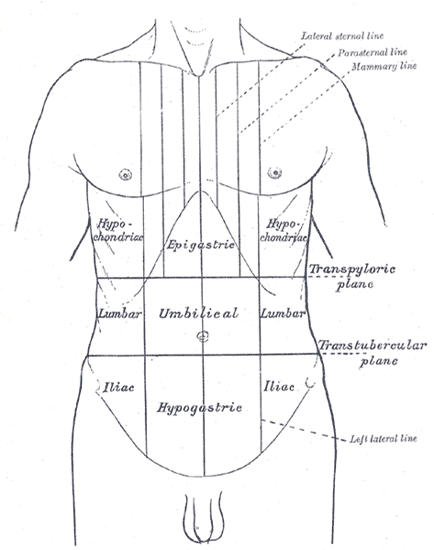
The lesser utilized dividing of the abdomen into 9 section is more academic than practical (though I would argue the more specific you can be in your documentation and conversation with consultants, the better).  To better orient to these regions you have to be familiar with the following four anatomic lines: transpyloric line (Addison’s plane), transtubercular line, and the left and right mammary line.

Gray1220

Drawing these 4 lines make up the “tic-tac-toe” board of the abdomen and the nine regions of the abdomen:


Right hypochondriacbody-regions-torso

Epigastric

Left hypochondriac

Right lumbar

Umbilical

Left Lumbar

Right iliac

Hypogastric

Left iliac


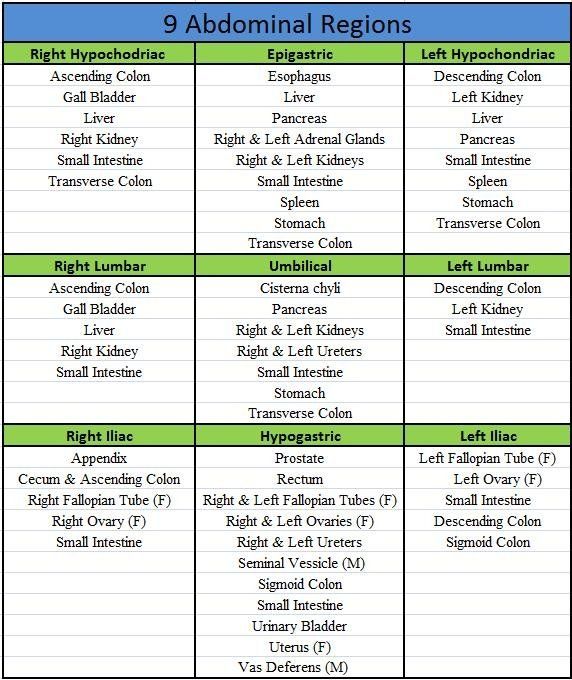
So what structures are found in each region?

Abdominal Organs and sections


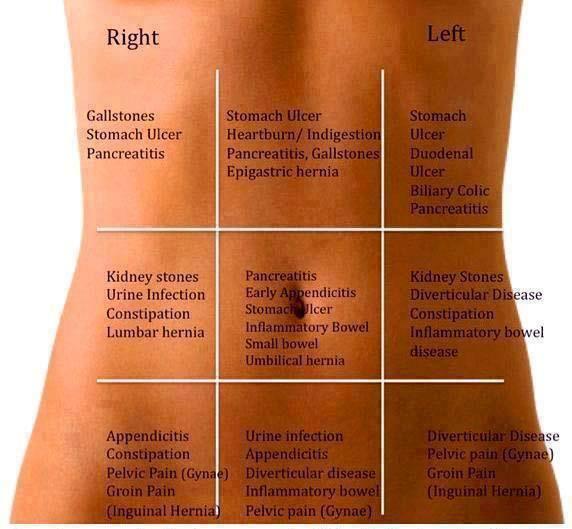
Now you know what organs are found in each section, what are some differential diagnoses for each region if a patient comes in with localized abdominal pain?

Abdominal Pain Differential


Surgery Question

Everyone is familiar with the four quadrant breakdown of the abdomen….but did you know that it can further be broken down into nine sections???

  1. Name the nine individual sections
  2. List the structures found in each sections
  3. Come up with at least three differential diagnoses for pain in each section