#40 – Well Child Visits


***LISTEN TO THE PODCAST HERE***


2015 American Academy of Pediatrics Schedule for Preventive Pediatric Health


2018 Centers for Disease Control Immunization Schedule


Denver Developmental Milestones


Initial Office Visit (within 2 weeks)


Development

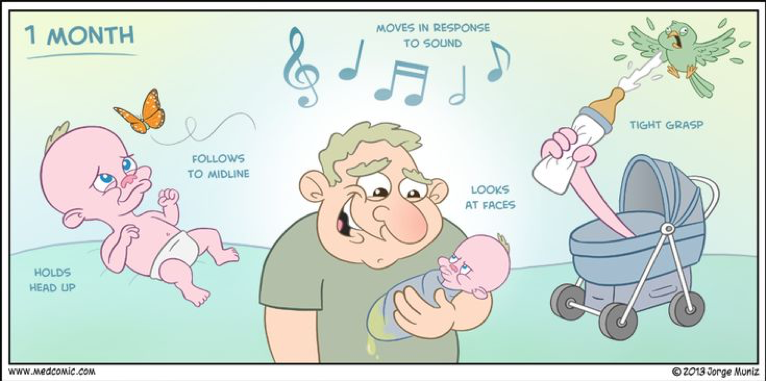
  • Rooting and suckling reflex strong
  • Indiscriminate tight grasp of hands
  • Responds to light, noise, and movement
  • Lift head from supine
  • Follow to midline
  • Regained birthweight


Anticipatory Guidance

  • Feeding
    • Encourage breastfeeding and its benefits:
      • Decreased risk of infections
      • Decreased SIDS risk
      • Decreased obesity risk
      • Increases emotional connection
    • Frequency
      • On-demand, but generally every 2-4 hours
    • Amount
      • 1 oz/kg/day
    • Reflux
  • Sleeping
    • Back to sleep
  • Fever
  • Jaundice

Vaccinations

  • Hepatitis B #1 (if not given in hospital)


2 Month Visit


Development

  • Smile socially and start cooing
  • Lift head from prone
  • Turns head towards sounds and follow past midline
  • Push up on arms from prone
  • Recognize parents


Anticipatory Guidance

  • Feedings
    • Start to delay middle of the night feedings
  • Sleep
    • Move to another room to help with self-soothing

Vaccinations

  • Hepatitis B #2
  • Rotavirus #1
  • DTaP #1
  • HIB #1
  • Pneumococcal #1
  • Polio #1


4 Month Visit


Development

  • Neonatal reflexes will begin to disappear
  • Smiles spontaneously
  • Likes to play/interact with people
  • Begins to babble
  • Different cries for different complaints
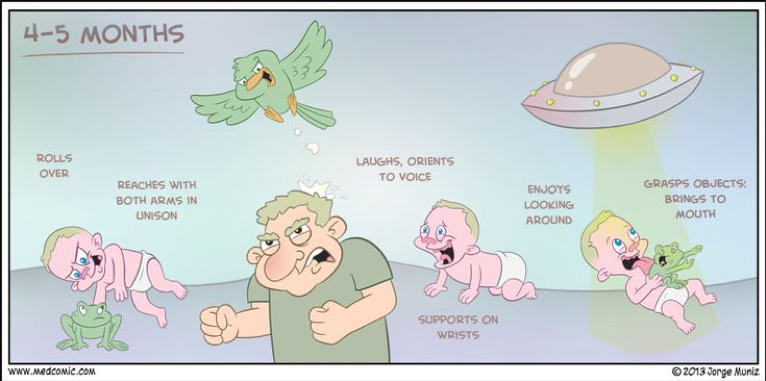
  • Reach with one hand
  • Uses hands and eyes together
  • Hold head unsupported and support on forearms when prone
  • Start rolling over prone to supine
  • Brings hands to mouth


Anticipatory Guidance

  • Feeding
    • 32oz/day = max
    • 4-5 feedings per day
    • Start to introduce rice cereal and solid foods
      • Counsel that stools will change
      • One food at a time
  • Sleeping
    • May start to sleep through the night
      • Counsel to start a bedtime routine
      • No more middle of night feedings

Vaccinations

  • Rotavirus #2
  • DTaP #2
  • HIB #2
  • Pneumococcal #2
  • Polio #2


6 Month Visit


Development

  • Doubled birth weight
  • Stranger danger
  • Likes to look at self in the mirror
  • Responds to name
  • Imitate speech
  • Voice happy and displeasure
  • Pass objects from hand to hand
  • Rollover in both directions
  • Sits unsupported


Anticipatory Guidance

  • Feeding
    • Increase solid foods and decrease formula
    • Introduce sippy cup
  • Sleeping
    • Separation anxiety common

Vaccinations

  • Rotavirus #3 (if indicated)
  • DTaP #3
  • HIB #3 (if indicated)
  • Pneumococcal #3
  • Polio #3
  • Hepatitis B #3
  • Influenza #1
  • Fluoride (if needed)


9 Month Visit


Development

  • Crawls
  • Understands “no”
  • Starts saying “mama” and “dada” indiscriminently
    • Takes 9 months to be a “mama”
  • Can point
  • Immature pincer grasp
  • Pull to stand and cruise
  • Wave “bye-bye”
  • Object permanence begins to develop

Anticipatory Guidance

  • Feedings
    • Milk/formula down to 24oz/day
    • Solid foods at meal time
    • Introduction of finger foods
  • Sleep
    • Should be through the night
    • Limit naps to 2x/day
  • Introduce brushing as teeth should begin erupting
  • Discipline plans

Vaccinations

  • Catch-up (if needed)
  • Influenza #2


12 Month Visit


Development

  • Begin walking unsupported
  • Increased vocabulary
  • Follow simple, one-step commands
  • Imitates actions and words
  • Help with dressing

Anticipatory Guidance

  • Feeding
    • Introduce cow’s milk not to exceed 24oz/day
    • Ween from bottle
    • Juice not to exceed 8oz/day
  • Sleep
    • Bedtime ritual is important
  • Discipline and Behavior Counseling
    • Set limits and be consistent
  • Can transition to forward facing car seat with harness if they exceed current manufacturers height/weight recommendations
  • Routine CBC for anemia screening

Vaccinations

  • HIB #3 or #4
  • Pneumococcal #4
  • MMR #1
  • Varicella #1
  • Hepatitis A #1


15 Month Visit


Development

  • Kick and roll ball
  • Can undress themselves
  • Play hide and seek
  • Attempts to name objects
  • Vocabulary up to 5 words
  • Build towers
  • Needs social interaction
    • Thought they don’t play well with others (sharing)

Anticipatory Guidance

  • Feeding
    • 3 balanced meals per day with 1-2 snacks
    • Introduce utensils
  • Sleeping
    • Down to 1 nap per day
    • Temper tantrums will be more common
    • Have crib on lowest rung
    • Child stays in room for bedtime
  • Discipline and Behavior
    • Praise for good behavior and redirect bad

Vaccinations

  • DTaP #4
  • HIB #4 (if indicated)
  • Hepatitis A #2


18 month Visit


Development

  • Plays simple pretend
  • Likes to explore, but needs parent close
  • Name body parts
  • Scribbles on their own
  • Climb stairs
  • Turn pages in books while reading
  • Put simple puzzles together

Anticipatory Guidance

  • Feedings
    • Drinking from cup exclusively and using utensils
    • Decrease milk to 16oz/day
  • Discipline and Behavior
    • Introduce “timeouts” for discipline

Vaccinations

  • Catch-up (if needed)


2 year Visit


Development

  • Gets excited and enjoys playing with others
  • Use two word sentences
  • Knows names of familiar people
  • Shows defiant behavior (Terrible Two’s)
  • Increase autonomy and self-expression
  • Echolalia
  • Begins to sort colors and shapes
  • Follow two-step commands
  • Build towers of 4-6 blocks
  • Start running
  • Throw and kick balls
  • Walk up and down stairs
  • Vocab up to 50 words and use two-word sentences

Anticipatory Guidance

  • Growth
    • 2-3 inches and 3-6 pounds for the year
  • Transition to toddler bed
  • Naps down to 1 a day
  • Begin potty training
  • Safety
    • House needs to be “babyproof” at this point
      • Door latches, baby gates, outlet covers, cabinet locks

Vaccinations

  • None


3 Year Visit


Development

  • Pedal a tricycle
  • 300 words in vocabulary
  • Sort objects by color and shape
  • Uses 3-5 word sentences
  • Repeat their name, age, and gender
  • Can play well with others (takes turns in games)
  • Follow 2-3 step commands
  • Copy a circle
  • Alternate feet on stairs

Anticipatory Guidance

  • Growth
    • 2-3 inches and 3-6 pounds from previous visit
  • Encourage autonomy and exploration with boundaries

Vaccinations

  • DTaP #5
  • Polio #4
  • MMR #2
  • Varicella #2


4 Year Visit


Development

  • Play “mom and dad”
  • Play is more creative with make-believe
  • Tell stories and ask questions
  • Sing songs
  • Play board games
  • Copy and recognize letters
  • Uses scissors
  • Understand the concept of counting
  • Copy a square (4 sides)
  • Speak in 4-5 word sentences
  • Increased emotional range and understands them

Anticipatory Guidance

  • Growth
    • 40 inches and 40 lbs at 4 years
  • Thrive on praise
  • Be consistent and balanced in discipline

Vaccinations

  • None


5 Year Visit


Development

  • Wants to be with and like friends
  • Follows rules more
  • Use future tense
  • Use full sentences
  • Fully aware of gender
  • Fully potty trained
  • Likes to sing, dance, and act
  • Count 10 objects correctly
  • Stand on one-leg for 10 seconds or longer
  • Draw a person with body parts
  • Can tell difference between real and make-believe

Anticipatory Guidance

  • Sibling jealously is common
  • Prepare for kindergarten
  • Start instilling morality in decision making
  • TV Guidelines
    • 1 hour per day max
    • Don’t use as a reward
    • Talk with other adults in house on plan


References

  1. 2015 Recommendations for Preventive Pediatric Health Care. Pediatrics. 2015;136(3):e727-e729 [link]
  2. 2018 CDC Immunization Schedule for Children and Adolescents 18 years or younger. [link]
  3. CDC – Developmental Milestones [link]
  4. Scharf RJ, Scharf GJ, Stroustrup A. Developmental Milestones. Pediatrics in review. 2016; 37(1):25-37; quiz 38, 47. [pubmed]
Ep-PAINE-nym


Wilson’s Disease


Other Known Aliases – progressive hepatolenticular degeneration


DefinitionAutosomal recessive condition that causes impaired copper metabolism leading to intoxication due to a mutation in the chromosome 13q14 resulting in faulty ATP7B protein production.

An external file that holds a picture, illustration, etc. Object name is nihms648222f1.jpg

Clinical SignificanceA rare, but devastating, disease if not identified early in its course.  It can effect multiple systems including:

  • Hepatic – elevated transaminases to fulminant liver failure
  • Hematologic – hemolytic anemia, jaundice
  • Neurologic – athetosis, tremors, dystonia
  • Psychiatric – behavior changes, learning difficulties
  • Ocular – Kayser-Fleischer rings (more on this next week)

Image result for wilson's disease

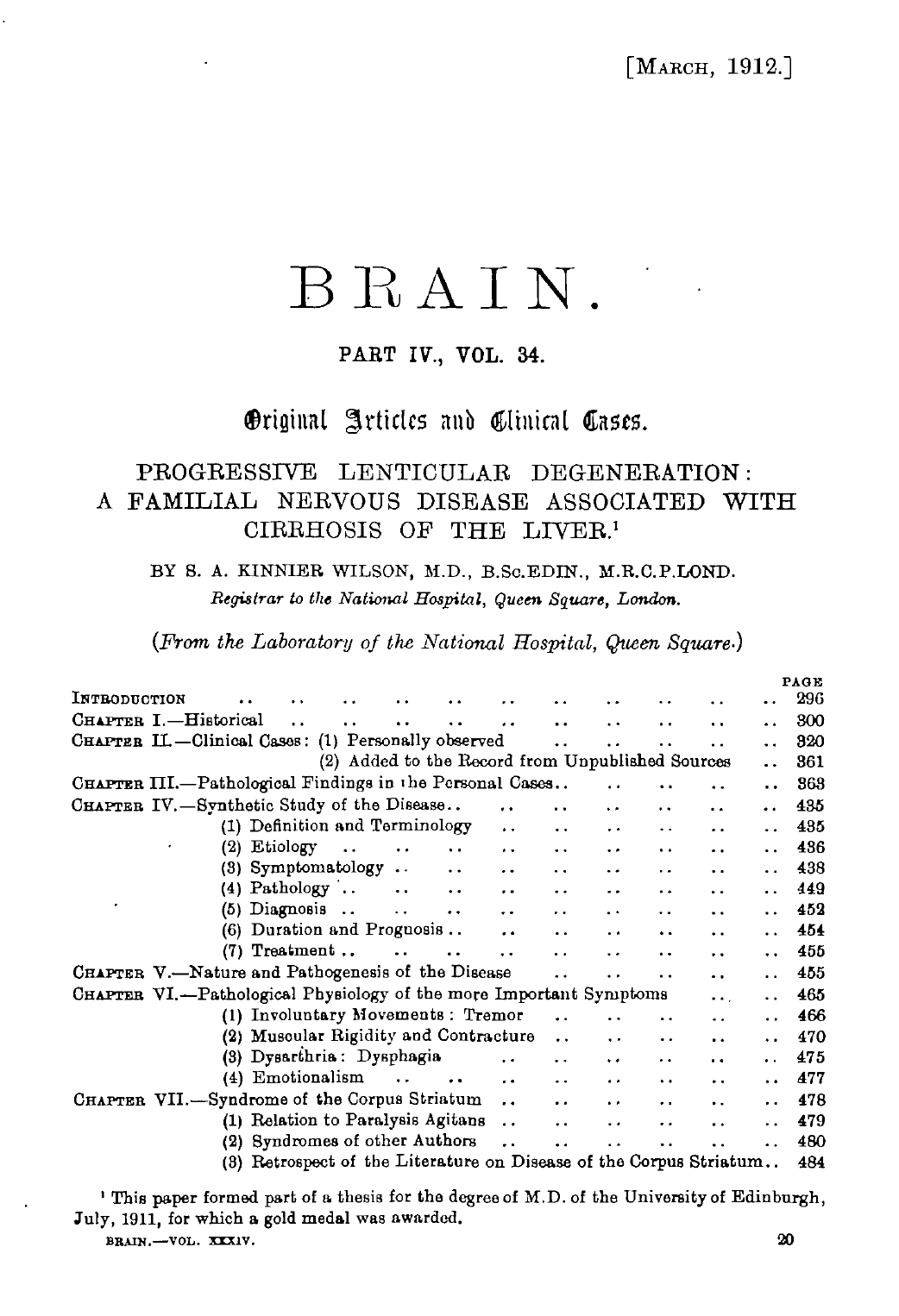
History – Named after Samuel Alexander Kinnier Wilson (1878-1937), who was an American-born, British neurologist.  He received his medical degree from the University of Edinburgh Medical School in 1902 and studied neurology with Joseph Babinsky at the Salpétriére Hospital in Paris before relocating back to London for the duration of his medical career.   He is also credited with introducing the neuropsychiatric term “extrapyramidal” into the medical lexicon.  He described his eponymous disease in his 1912 medical dissertation where it gained its notoriety, but was first recorded in 1854 by Friedrich Theodor von Freichs.

Samuel Alexander Kinnier Wilson.jpg


References

  1. Firkin BG and Whitwirth JA.  Dictionary of Medical Eponyms. 2nd ed.  New York, NY; Parthenon Publishing Group. 1996.
  2. Bartolucci S, Forbis P.  Stedman’s Medical Eponyms.  2nd ed.  Baltimore, MD; LWW.  2005.
  3. Yee AJ, Pfiffner P. (2012).  Medical Eponyms (Version 1.4.2) [Mobile Application Software].  Retrieved http://itunes.apple.com.
  4. Whonamedit – dictionary of medical eponyms. http://www.whonamedit.com
  5. Rodriguez-Castro KI, Hevia-Urrutia FJ, Sturniolo GC. Wilson’s disease: A review of what we have learned. World journal of hepatology. 2015; 7(29):2859-70. [pubmed]
  6. Patil M, Sheth KA, Krishnamurthy AC, Devarbhavi H. A review and current perspective on Wilson disease. Journal of clinical and experimental hepatology. 2013; 3(4):321-36. [pubmed]
  7. Bandmann O, Weiss KH, Kaler SG. Wilson’s disease and other neurological copper disorders. The Lancet. Neurology. 2015; 14(1):103-13. [pubmed]
  8. Kinnier Wilson SA.  Progressive Lenticular Degeneration: A Familial Nervous Disease Associated with CIrrhosis of the Liver.  Brain. 1912;34(4):295-507

PAINE #PANCE Pearl – Oncology

Question


27yo male, with stage II Hodgkin’s lymphoma, presents to his oncologists’s office for 6-week follow-up s/p 4 cycles of ABVD chemotherapy.  He reports malaise and fatigue, but is otherwise in good spirits.  Vitals show:

  • BP – 122/72 mmHg
  • HR – 96 bpm
  • RR – 15 bpm
  • O2% – 100% on room air
  • Temperature – 38.5oC (101.4oF)


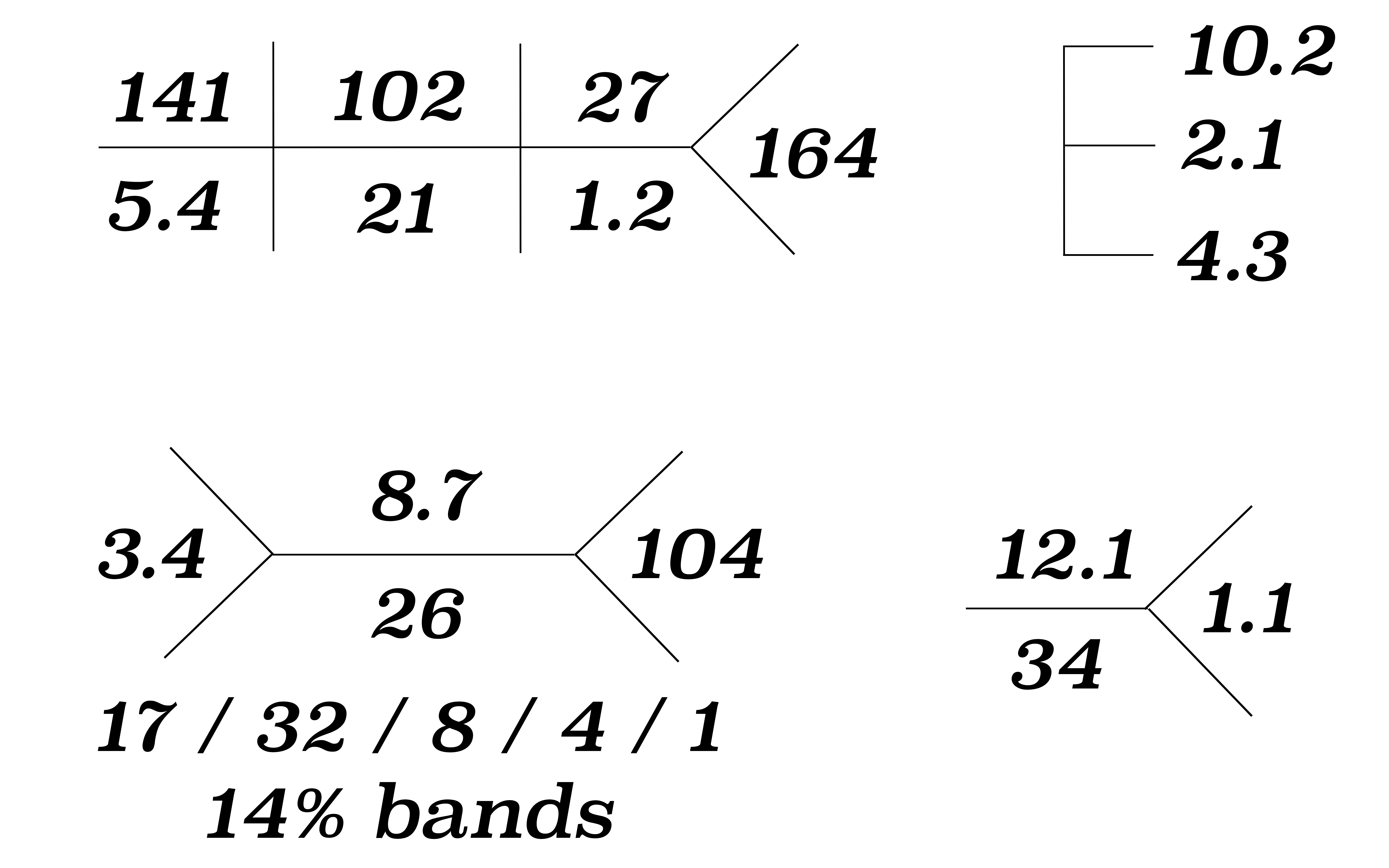
Labs in the office are below:


Answer


This patient has a neutropenic fever.  This is an oncologic emergency because their immune systems has been completely destroyed by the chemotherapy and they are unable to mount an appropriate response to the infectious insult. In order to determine if a patient is neutropenic, you must calculate an Absolute Neutrophil Count (ANC).

MD Calc Link

Neutropenia =  ANC < 1500


Ep-PAINE-nym


Hodgkin’s Lymphoma


Other Known Aliasesnone


Definition – Type of lymphoma predominantly from lymphocytes that arise from germinal center or post-germinal center of B cells


Clinical SignificanceAccounts for 10% of all lymphomas and 0.6% of all cancers.  It is also associated with a bimodal age distribution of young adults (20s) and older adults (60s), with a slight male predominance.  Epstein-Barr virus is the most common causative agent and it carries a favorable prognosis.


History – Named after Thomas Hodgkin (1798-1866), who was British physician and considered one of the most prominent pathologists of his time.  He was also a perpetual student constantly learning new techniques including being an early adopter of the stethoscope anda fervent advocate for preventative medicine.  He first described his findings on his eponymous disease in 1832, but it wasn’t until 33 years later when another British physician, Samuel Wilks, “re-discovered” the disease and Hodgkin’s work did it gain any traction and recognition.


Thomas Hodgkin photo.jpg


References

  1. Firkin BG and Whitwirth JA.  Dictionary of Medical Eponyms. 2nd ed.  New York, NY; Parthenon Publishing Group. 1996.
  2. Bartolucci S, Forbis P.  Stedman’s Medical Eponyms.  2nd ed.  Baltimore, MD; LWW.  2005.
  3. Yee AJ, Pfiffner P. (2012).  Medical Eponyms (Version 1.4.2) [Mobile Application Software].  Retrieved http://itunes.apple.com.
  4. Whonamedit – dictionary of medical eponyms. http://www.whonamedit.com
  5. Hodgkin Lymphome.  British Medical Journal – Best Practice. http://bestpractice.bmj.com/topics/en-us/311
  6. Hodgkin T.  On Some Morbid Appearances of The Absorbent Glands and Spleen.  Med Chir Trans.  1832;17:68-114.

PAINE #PANCE Pearl – Oncology


27yo male, with stage II Hodgkin’s lymphoma, presents to his oncologists’s office for 6-week follow-up s/p 4 cycles of ABVD chemotherapy.  He reports malaise and fatigue, but is otherwise in good spirits.  Vitals show:

  • BP – 122/72 mmHg
  • HR – 96 bpm
  • RR – 15 bpm
  • O2% – 100% on room air
  • Temperature – 38.5oC (101.4oF)


Labs in the office are below:


Ep-PAINE-nym


Auer Rods


Other Known Aliasesnone


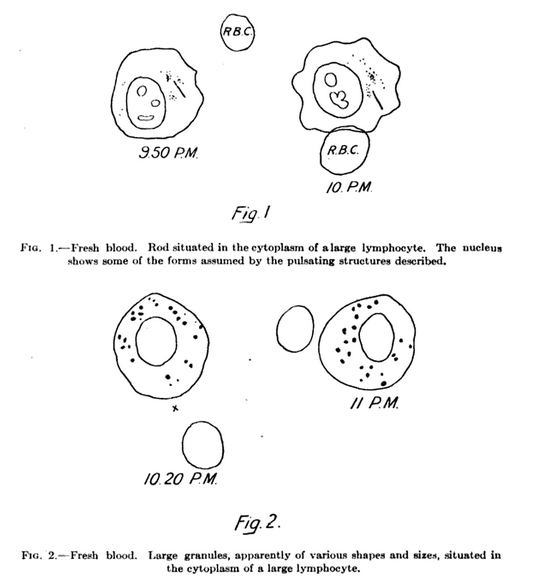
Definition – Auer rods are azurophilic granules found in the cytoplasm of leukemic blast cells and are composed of fused lyosomes.


Image result for auer rods


Clinical SignificanceThese are found in high grade myelodysplastic and myeloproliferative syndromes and are pathognomonic for acute myelogenous leukemia (AML).


Image result for auer rods


History – Named after John Auer (1875-1948), an American physiologist and pharmacologist, who held appointments at Johns Hopkins Hospital, Rockefeller Institute for Medical Research, and the St. Louis School of Medicine. He first described these structures in a 21yo male who was suffering from a sore throat and nosebleed and admitted to Sir William Osler’s service for work-up.  He published this finding in 1906, but were first described by a colleague of his at Johns Hopkins Hospital, Thomas McCrae.  Interestingly, they both erroneously thought that the cells containing these structures were lymphoblasts, not myeloblasts.


Image result for john auer rods

scanned image of page 404


References

  1. Firkin BG and Whitwirth JA.  Dictionary of Medical Eponyms. 2nd ed.  New York, NY; Parthenon Publishing Group. 1996.
  2. Bartolucci S, Forbis P.  Stedman’s Medical Eponyms.  2nd ed.  Baltimore, MD; LWW.  2005.
  3. Yee AJ, Pfiffner P. (2012).  Medical Eponyms (Version 1.4.2) [Mobile Application Software].  Retrieved http://itunes.apple.com.
  4. Whonamedit – dictionary of medical eponyms. http://www.whonamedit.com
  5. Gordon SW, Krystal GW. Auer Rods. NEJM. 2017; 376(21):2065. [pubmed]
  6. Auer J. Some hitherto Undescribed Structures Found in the Large Lymphocytes of a Case of Acute Leukemia. AJMS. 1906;131(6):1002-1014 [article]
  7. McCrae T. Acute Lymphatic Leukemia, with Report of Five Cases. BMJ. 1905; 1(2304):404-8. [pubmed]
  8. John Auer. http://www.iqb.es/historiamedicina/personas/auer.htm

Ep-PAINE-nym


Hunter’s Ligament


Other Known Aliasesround ligament of the uterus, ligamentum teres uteri


Definition – These are the lateral attachments of the uterus that originate at the uterine horns and extend out immediately below and in front of the fallopian tubes.  They also cross the external lliac vessels before entering the inguinal canal.

Gray1138.png


Clinical SignificanceThis ligament maintains uterine anteversion during pregnancy and can cause pain as they stretch


History – Named after William Hunter (1718-1783), who was a Scottish anatomist and obstetrician, and was the younger brother of John Hunter (an even more famous anatomist).  He studied extensively on anatomy, with particular interests in obstetrical anatomy, and was also appointed as the chief physician to Queen Charlotte in 1764.  His namesake ligaments come from his posthumously published textbook An Anatomical Description of the Human Gravid Uterus in 1794.


William Hunter (anatomist).jpg


References

  1. Firkin BG and Whitwirth JA.  Dictionary of Medical Eponyms. 2nd ed.  New York, NY; Parthenon Publishing Group. 1996.
  2. Bartolucci S, Forbis P.  Stedman’s Medical Eponyms.  2nd ed.  Baltimore, MD; LWW.  2005.
  3. Yee AJ, Pfiffner P. (2012).  Medical Eponyms (Version 1.4.2) [Mobile Application Software].  Retrieved http://itunes.apple.com.
  4. Whonamedit – dictionary of medical eponyms. http://www.whonamedit.com
  5. Hunter W.  An Anatomic Description of the Human Gravid Uterus.  1794. London