
Ep-PAINE-nym


Reye’s Syndrome


Other Known AliasesReye’s sequence, Reye-Morgan-Baral syndrome, Reye-Johnson syndrome

Definition – Rare disease of acquired encephalopathy and fatty liver filtration in children under 15 years of age

Clinical Significance Classically, this condition follows a viral upper respiratory illness (influenza B, varicella) in children who were given aspirin for fever therapy.  Symptoms include vomiting, confusion, AMS, seizures, and LOC. Children under 5 years of age frequently have hyperglycemia as well.  Mortality is as high as 40% and many that survive are left with significant brain damage.

History – First described in 1929 by Dr. W.R. Brain, D. Hunter, and H.M. Turnbull, but not established as clinical diagnosis until published in The Lancet in 1963 by Dr. Ralph Douglass K. Reye, Dr. Graeme Morgan, and Dr. James Baral,.  Later that same year (1963), an outbreak of this condition occurred in North Carolina and was published by Dr. George Johnson.


References

  1. Firkin BG and Whitwirth JA.  Dictionary of Medical Eponyms. 2nd ed.  New York, NY; Parthenon Publishing Group. 1996.
  2. Bartolucci S, Forbis P.  Stedman’s Medical Eponyms.  2nd ed.  Baltimore, MD; LWW.  2005.
  3. Yee AJ, Pfiffner P. (2012).  Medical Eponyms (Version 1.4.2) [Mobile Application Software].  Retrieved http://itunes.apple.com.
  4. Whonamedit – dictionary of medical eponyms. http://www.whonamedit.com/. Accessed March 7, 2017.
  5. Brain, WR, Hunter, D, Turnbull, HM. Acute meningoencephalomyelitis of childhood: report of six cases. Lancet. 1929;1:221–227 [article]
  6. Reye RDK, Morgan G, Baral J. Encephalopathy and fatty degeneration of the viscera: A disease entity of childhood. Lancet. 1963; 2(7311):749-52. [pubmed]
  7. Johnson GM, Scurletis TD, Carroll NB. A study of sixteen fatal cases of encephalitis-like disease in North Carolina children. North Carolina medical journal. 1963; 24:464-73. [pubmed]
Ep-PAINE-nym


Hatchcock’s Sign


DefinitionUpward pressure applied to the angle of mandible produces pain with parotitis, but not with adenitis

Clinical Significance – This particular sign could be positive before any significant parotid gland swelling occurred and would aid in the early detection and diagnosis of mumps. 

History – First described by a Lieutenant Hatchcock in 1918.  Honestly, I can’t find much on this Lieutenant Hatchcock……


References

  1. Firkin BG and Whitwirth JA.  Dictionary of Medical Eponyms. 2nd ed.  New York, NY; Parthenon Publishing Group. 1996.
  2. Bartolucci S, Forbis P.  Stedman’s Medical Eponyms.  2nd ed.  Baltimore, MD; LWW.  2005.
  3. Yee AJ, Pfiffner P. (2012).  Medical Eponyms (Version 1.4.2) [Mobile Application Software].  Retrieved http://itunes.apple.com.
  4. Lincoln Evening Journal.  Lincoln, NE. 1918. https://www.newspapers.com/newspage/40559204/
  5. Practical Medicine Series.  General Medicine. Volume I.  1919. http://tinyurl.com/n3c4yqa

Ep-PAINE-nym


Aicardi Syndrome

DefinitionCongenital syndrome with three main features:

  1. Agenesis or dysgenesis of the corpus callosum
  2. Infantile spasms and/or epilepsy
  3. Chorioretinal lacunae

Clinical Significance Occurs almost exclusively in females and clinical findings can include:

  • Asymmetry of cerebrum
  • Ventricular cysts
  • Microcephaly
  • Severe developmental delay and disability
  • Ocular abnormalities (microphthalmia, colobomo)
  • Short philtrum with flat nose and upturned ears
  • Sparse eyebrows
  • Small hands
  • Spinal abnormalities

History – Named after Dr. Jean Fraçois Marie Aicardi, who is a French pediatrician, and first published and described this disorder in two girls in 1965.


References

  1. Firkin BG and Whitwirth JA.  Dictionary of Medical Eponyms. 2nd ed.  New York, NY; Parthenon Publishing Group. 1996.
  2. Bartolucci S, Forbis P.  Stedman’s Medical Eponyms.  2nd ed.  Baltimore, MD; LWW.  2005.
  3. Yee AJ, Pfiffner P. (2012).  Medical Eponyms (Version 1.4.2) [Mobile Application Software].  Retrieved http://itunes.apple.com.
  4. Whonamedit – dictionary of medical eponyms. http://www.whonamedit.com/
  5. J. Aicardi, J. Lefebvre, A. Lerique-Koechlin. A new syndrome: Spasm in flexion, callosal agenesis, ocular abnormalities. Electroencephalography and Clinical Neurophysiology. 1965;19:609-610.

Ep-PAINE-nym


Kahler’s Disease


Other Known AliasesMacIntyre Syndrome

DefinitionMultiple Myeloma

Clinical Significance None

History – Given to Dr. Otto Kahler (1849-1893), who was a Austrian physician and Professor of Medicine at the German University in Prague.  Although he is the namesake for this condition, William MacIntyre (1791-1857) first described multiple myeloma in 1850.


References

  1. Firkin BG and Whitwirth JA.  Dictionary of Medical Eponyms. 2nd ed.  New York, NY; Parthenon Publishing Group. 1996.
  2. Bartolucci S, Forbis P.  Stedman’s Medical Eponyms.  2nd ed.  Baltimore, MD; LWW.  2005.
  3. Yee AJ, Pfiffner P. (2012).  Medical Eponyms (Version 1.4.2) [Mobile Application Software].  Retrieved http://itunes.apple.com.
  4. Whonamedit – dictionary of medical eponyms. http://www.whonamedit.com/. Accessed March 7, 2017.
  5. Kahler O.  Zur Symptomatologie des multiplen Myeloms. Beobachtung von Albumosurie. Prager medicinische Wochenshrift, Prague, 1889, 14: 33-35, 44-49.
  6. Macintyre W. Case of Mollities and Fragilitas Ossium, accompanied with urine strongly charged with animal matter. Medico-chirurgical transactions. 33:211-32. 1850. [pubmed]
  7. Kyle RA, Rajkumar SV. Multiple myeloma. Blood. 2008;111(6):2962-2972 [pubmed]

Ep-PAINE-nym


Apt-Downey Test


Other Known Aliases – alkali denaturation test

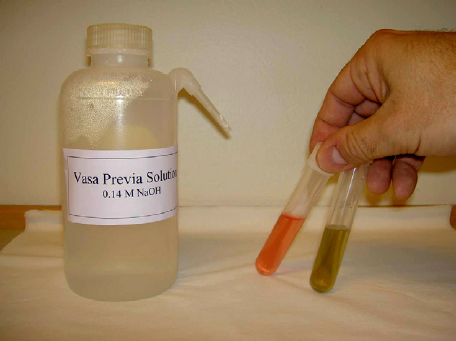
DefinitionLab test where the blood sample is hemolyzed using sterile water and centrifuged to produce a hemoglobin supernatent.  This is then mixed with 1% NaOH.  Fetal hemoglobin will stay pink, while maternal hemoglobin will turn yellow/brown.

fig-2-the-complete-vasa-previa-testing-setup-shown-a-beaker-of-014-m-naoh-and-two

Clinical SignificanceHelps differentiate maternal from fetal blood in cases of vaginal bleeding or neonatal hematemesis/hematochezia.

History – Given to Dr. Leonard Apt and Dr. William Downey, Jr., who were physicians at Harvard Medical School and Children’s Medical Center in Boston, MA in the mid-1900’s.


References

  1. Firkin BG and Whitwirth JA.  Dictionary of Medical Eponyms. 2nd ed.  New York, NY; Parthenon Publishing Group. 1996.
  2. Yee AJ, Pfiffner P. (2012).  Medical Eponyms (Version 1.4.2) [Mobile Application Software].  Retrieved http://itunes.apple.com
  3. Apt L, Downey WS. Melena neonatorum: the swallowed blood syndrome; a simple test for the differentiation of adult and fetal hemoglobin in bloody stools. The Journal of Pediatrics. 47(1):6-12. 1955. [pubmed]

Ep-PAINE-nym


Ferguson’s Reflex


Other Known AliasesFetus Ejection Reflex

DefinitionStimulation of the cervix leading to contraction of the uterus through oxytocin release.

Clinical SignificanceDemonstrates positive feedback during labor and delivery to increase uterine contractions as cervical dilation progresses. Long standing belief that epidural anesthesia before cervical dilation increased risk of cesarean section (this was debunked in 2005).

History – Given to Dr. James Ferguson, a Canadian obstetrician, in 1940 after he showed this physiologic effect in rabbits and postulated it to be true in humans.


References

  1. Firkin BG and Whitwirth JA.  Dictionary of Medical Eponyms. 2nd ed.  New York, NY; Parthenon Publishing Group. 1996.
  2. Wong CA, Scavone BM, Peaceman AM. The risk of cesarean delivery with neuraxial analgesia given early versus late in labor. The New England journal of medicine. 2005;352(7):655-65. [pubmed]
  3. Newton N.  The fetus ejection reflex revisited.  Birth.  1987;14(2):106-108.

Ep-PAINE-nym


Chadwick Sign


DefinitionBlue discoloration of the cervix and vaginal mucosa seen in early pregnancy.

Clinical SignificanceDue to increased blood flow to support a newly implanted embryo and can be seen 6-8 weeks after conception.

History – Given to James R. Chadwick, an American gynecologist of the late 19th century, after he read a paper before the American Gynecologic Society in 1886, but 1st described by Etienne Jacquemin in 1836.  Dr. Chadwick did give appropriate recognition to Dr. Jacquemin during this presentation.


References

  1. Firkin BG and Whitwirth JA.  Dictionary of Medical Eponyms. 2nd ed.  New York, NY; Parthenon Publishing Group. 1996.
  2. Gleichert JE. Etienne Joseph Jacquemin, discoverer of ‘Chadwick’s sign’. Journal of the history of medicine and allied sciences. 1971;26(1):75-80. [pubmed]

Ep-PAINE-nym


Bainbridge Reflex


Other known aliasesAtrial Reflex

DefinitionCompensatory increase in heart rate caused by a rise in right atrial pressure.  Opposite of carotid baroreceptors.

Clinical SignificanceRespiratory sinus arrythmia.  Inspiration causes increased venous return.

History – Described by Francis Arthur Bainbridge in 1915


References

  1. Hakumäki MO. Seventy years of the Bainbridge reflex. Acta physiologica Scandinavica. 1987;130(2):177-85. [pubmed]
  2. Firkin BG and Whitwirth JA.  Dictionary of Medical Eponyms. 2nd ed.  New York, NY; Parthenon Publishing Group. 1996.
  3. http://www.healio.com/cardiology/learn-the-heart/cardiology-review/topic-reviews/bainbridge-reflex